
Why Sitting Still Can Make You a Better Wildlife Photographer
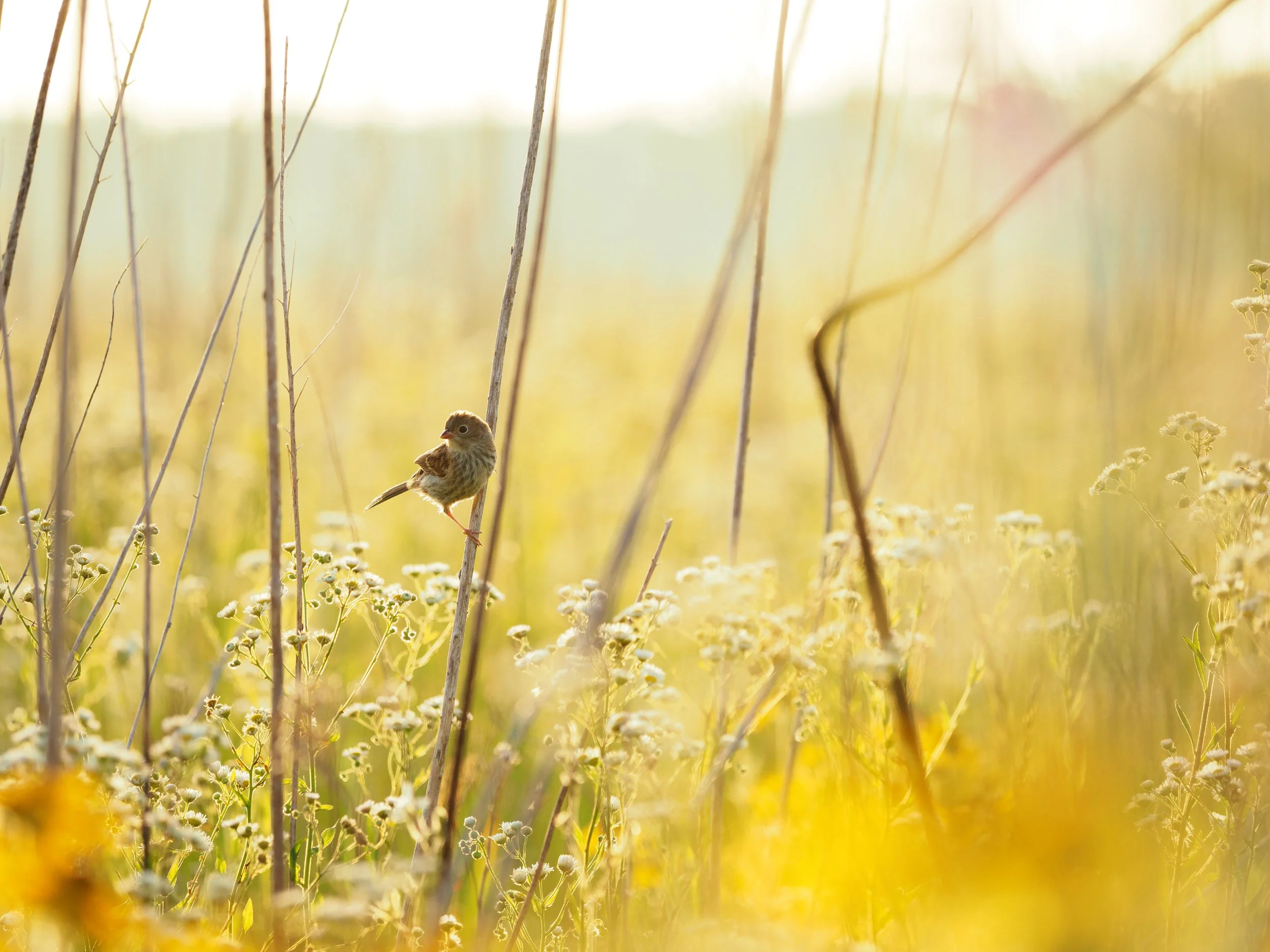
Juvenile Field Sparrow (Spizella pusilla) with the rising sun.
OM-5 Mark II + OM 40-150mm f/4
I located a family of field sparrows that consistently went down into a section of grass. When he birds flew away, I positioned myself near that area and waited. It did not take long for the birds to return and offer this opportunity.
There are often two main approaches to wildlife photography. The active method, hiking to different locations, spending limited time in any one area to locate as much as you can in the time you have. The instinct is to keep moving, with the fear of missing out on a great opportunity further down the trail.
The second method is the slower approach, choosing a location to sit and wait to see what unfolds before you.
In my experience, many people I have worked with or talked to have mentioned that they opt for the first option, where they are out hiking and moving around with their gear to find the wildlife.
There is definitely a time and place for this approach. Needing to cover large areas to reach a specific location, or photographing a very mobile species.
This approach also works well when exploring new areas, or if photography is not the primary objective of the outing.
If your main focus is wildlife photography and achieving pleasing compositions, I would argue that the option of sitting and waiting is the more productive approach. This slower deliberate approach is how I have had many of my favorite wildlife encounters. This includes opportunities with waterfowl, black bears, wading birds, shorebirds, and songbirds.
The Challenge:
The aspect that holds many photographers back from trying this method is the fear that they will choose a location that will not provide any good results, and result in a “wasted” outing without taking a single photo.
My goal with this post is to offer some insights into how to pick a good location to set up and the benefits of this method of wildlife photography.
Choosing a Location:
The first and most important aspect of this type of photography is finding and setting up in a productive location. The secret weapon to finding productive areas is planning and research prior to you heading out into the field.
If you do not know the wildlife in your area, you will likely have a very hard time determining what a productive spot will look like.
Field guides can offer a great first resource in determining what species are likely to be found in your area, and often provide details about that species interactions and life history.
When researching the animals in your area, some key things to pay attention to are:
Where does that animal live (habitat preferences)
What does that animal eat
How/ when does the animal reproduce (Mating time, nest, burrow?)
These three things will help you identify where that animal is likely to be found throughout the year.
The last important factor to consider are sources of water nearby. All animals need water, and habitats containing water or found adjacent to water will often yield higher abundance and diversity of species than areas where water is not present. When in doubt, head down to water!
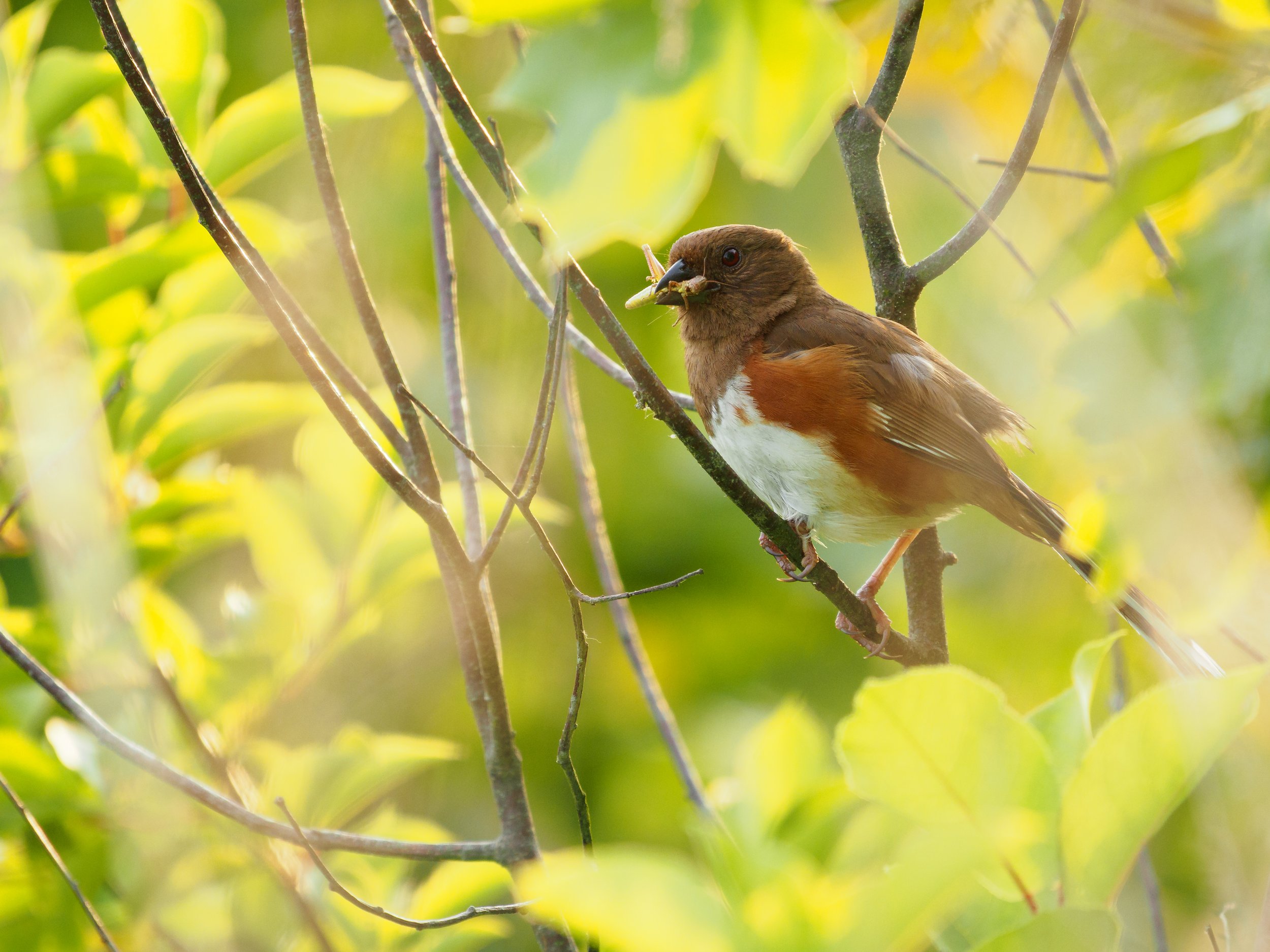
A female eastern Towhee carries a grasshopper back to a nest.
OM-5 Mark II + OM 150-400mm f/4.5
Case Study:
Eastern Towhee (Pipilo erythrophthalmus)
Where does it live?
This species is often associated with edge habitat in areas with dense understory growth and a large accumulation of leaf litter on the ground. The species prefers open canopy areas, and is often associated with later stages of field thicket growth where young saplings have started to take over. The towhee can be found in both wet or dry areas. The species is found all along the eastern United States from the Mississippi River eastward. The species migrates to breed north in May, roughly from Maryland North through Maine and the Canada Border Westward. The species is a year-round resident in southern states. The migrants return to the southern states for the winter, south of Maryland.
What does it eat?
The Towhee is an omnivore eating a variety of seeds, fruits, and insects. The species uses the dense leaf litter to locate insects and seeds on the ground. The preferred habitat has many low branches which it can perch on and dive down to grab insects it locates. The bird commonly forages in dense cover and comes out in exposed areas to forage only when cover is nearby.
How and when do they reproduce?
Birds build a nest typically located on the ground at the base of a tree or shrub. Nesting occurs as early as mid March in southern regions, and as late as mid July for second and third broods. Nests are typically an open cup formation of sticks and leaf matter. Both males and females bring food to the young with early food being primarily insects. Both males and females continue to feed the young birds about 3-4 weeks after they leave the nest.
From this information above, you can start to get a good sense of where this species is likely to be located. This knowledge allows you to focus your efforts on edge habitat with dense shrub layers, typical of overgrown fields and forest edges.
You can use this process on any species you are interested in finding and photographing and this planning will save you hours in the field wandering around trying to locate a species by sight alone, especially when this species is raising young, when it has quieted down.
The Benefits of Setting Up and Waiting:
Wildlife Begins to Ignore you
After about 15-30 minutes, bird behavior often returns to normal, as if you are not even there. You do not need to be in camouflage to go unnoticed when you are sitting still, however camo can greatly reduce the wait time for activity to return. Movement alerts animals much more than a stationary subject does.
Field Note:
A great example of this was a recent trip down to the local river. I found a nice spot on a rocky bank and sat there. I wasn’t wearing any camouflage, and I wasn't even particularly hidden. Within about a half hour, there were nearly a half a dozen Common Grackles (Quiscalus quiscula) foraging on the rocks around me, finding small insects among the rocks. They were soon joined by American Robins (Turdus migratorius) and American Goldfinches (Spinus tristis) coming down to drink and bathe in the shallow water. A Great Blue Heron (Ardea herodias) landed and started hunting on the opposite bank from me, and a White-tailed Deer (Odocoileus virginianus) and her fawn walked down along the bank towards me before they spotted me and moved into the brush.
All of this was made possible by simply finding a spot, sitting down on a foam mat, and being patient.
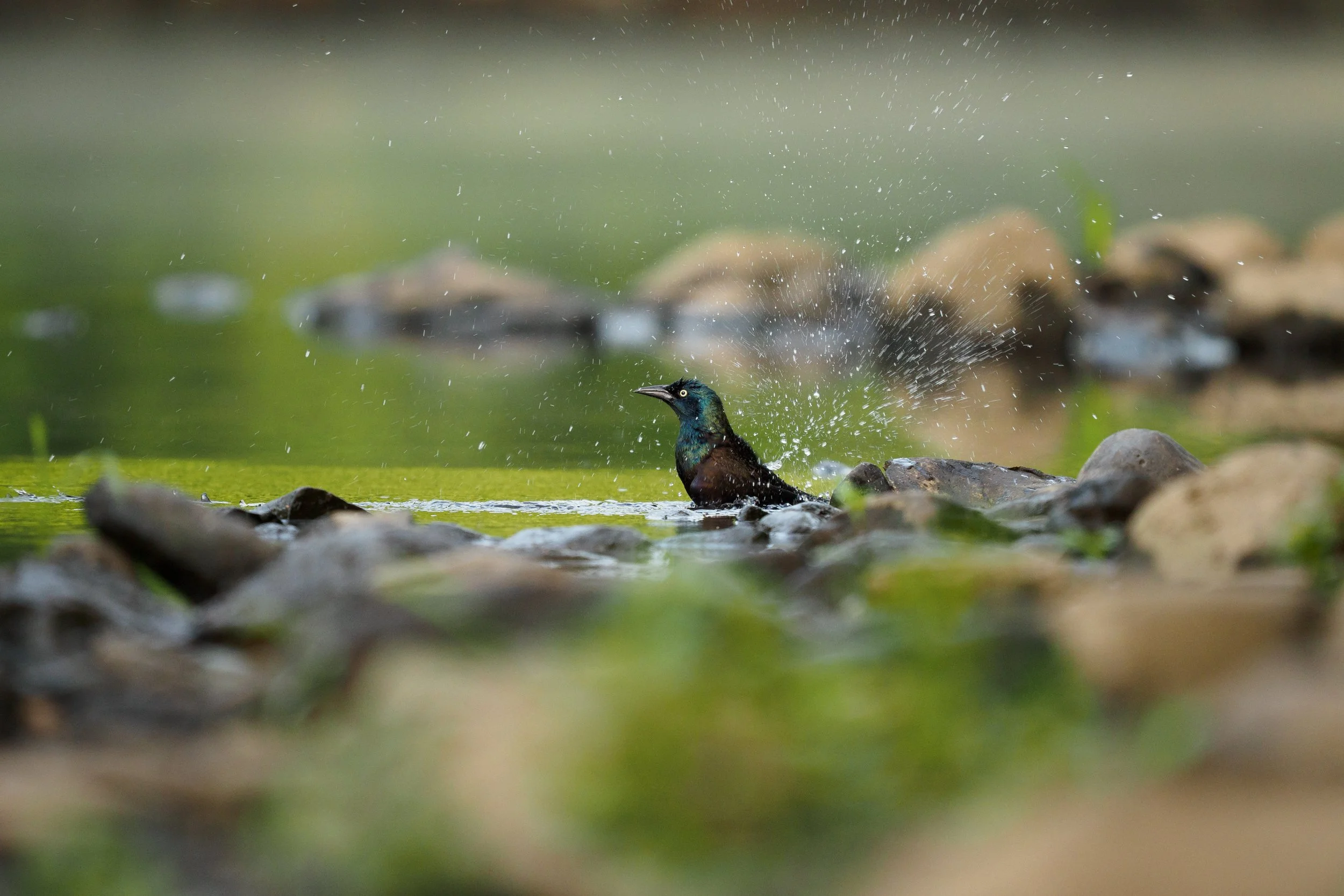
A Common Grackle takes a bath in the shallow water.
OM-5 Mark II + OM 150-400mm f/4.5
You Notice More Around You
The second huge advantage of sitting in one location, is it allows the opportunity to observe what is happening around you to a much greater extent then if you were actively moving through an area. You can begin to notice and recognize the faint calls of the birds in the brush around you, and then see as they pop out for a few seconds to catch an insect before retreating to the brush again. You can begin to notice that the birds tend to come from a consistent direction and then fly off back to that direction, presumably back to the nests to feed their young. You can notice that the heron has a favorite foraging location, after it has come back and visited this same log three times now since you have been sitting here. You can also witness things that you otherwise never would have seen.
Field Note:
The sun was just starting to come up and there was a low fog over the water. The rising sun made it appear to glow and out of the corner of my eye I spotted movement in the orange fog. There were five round objects crossing just downstream from me. I raised my camera and saw five racoons (Procyon lotor), one adult and four young, crossing along the shallow section of the river. They crossed and then climbed up along the rocks of the opposite bank. The adult collected her young and made sure everyone was accounted for before continuing on walking along the bank looking for food, and then disappearing into the brush.
Because I was sitting still, I was able to observe the natural behavior of this adult interacting and teaching her young how to dig for and find food along the river bank.
The longer you sit in one location, the more you begin to notice how much you miss when you are constantly on the move.
Changes in Lighting
As you stay in one location long enough, you will begin to notice how the lighting changes around you. This can either be for better or worse, but the observation alone can help you build better compositions and help you plan for future outings.
Whether it be the sun rising to allow you to raise your shutter speed, or a cloud passing to reduce the harsh highlights and dark shadows. Any number of factors can happen that can create new and interesting opportunities for you and your camera.
Better Compositions
Just because you are sitting in one area, does not mean you can't adjust your position slightly to take advantage of what you are noticing in front of you. If you notice that a particular bird is consistently perching in an area in front of you, but you don’t have the best angle. Wait for the bird to leave the area and move to get into a slightly better position. Move slowly and deliberately so as to not draw too much attention to your presence.
Now when the bird returns, you can be in a better position to capture the best possible composition. You can take this a step further and prefocus on favorite perches, and use modes like ProCapture to be able to capture the birds landing and taking off from these perches to add greater variety to the kinds of photos you can capture.
By taking the time in an area and recognizing which areas are commonly used by the animals, you can really work on refining your compositions and return to those areas when the light will be the best.
Learn Wildlife Behavior
One of the greatest advantages to setting up and waiting in one area, is the ability to observe and in turn, learn wildlife behavior. By letting the activity unfold around you, you will be able to witness activity that would have otherwise gone unnoticed if you were just passing through. A low branch that a gray catbird keeps landing on before going to the ground to forage, the direction the grackles take off to carry insects back to their young, the fallen tree trunk that is a favorite perch for the blue heron to fish from. These patterns will help you not only in the moment while you are there, but also help you in future outings. You can begin to recognize patterns and similarities in behavior and conditions in other habitats and locations. This will allow you to set yourself up more effectively even in locations where you have never visited before.
Take this a step further and start taking notes of the behavior you are observing. Create your own species accounts detailing the behavior you witness in front of you. After a few months or years, you will have pages full of detailed observations, making you a naturalist first and a wildlife photographer second.
Being a good observer and recognizing patterns of behavior will make you much more likely to successfully locate wildlife out in the field.
Being More Immersed in Nature
When practicing this type of wildlife photography, there is a key mindset shift that occurs. The success of the outing is no longer measured by how many species you saw or the number of images you took. Instead, the experience in the field takes center stage and the photography becomes part of that experience rather than the sole purpose of the outing.
You begin to notice the small things, how the light changes, the wind blowing the grasses around you, the water droplets on the vegetation, the small movements of the animals in front of you. The experience becomes more wholesome even if wildlife activity is slow.
The question you need to ask yourself is:
Do you want to hike around and be frustrated when you don't find anything to photograph?
Or
Do you want to sit and soak up all that nature has to offer around you, with the chance to let wildlife unfold around you?
So next time you are out, I challenge you to find locations to sit and spend a half hour to an hour. Just sit and observe what happens around you. With practice you will begin to have better encounters and more meaningful compositions, and you will see the images you produce change from snapshots, to works of art.
-Todd
If you’re looking to improve your wildlife photography or get more out of your OM System gear, I also offer one-on-one wildlife photography mentorship sessions where we can go deeper into topics like field technique, autofocus setup, and wildlife behavior.