
What Photographing a House Wren Family Taught Me About Wildlife Photography
Spending time with the same animals to improve your wildlife photography.
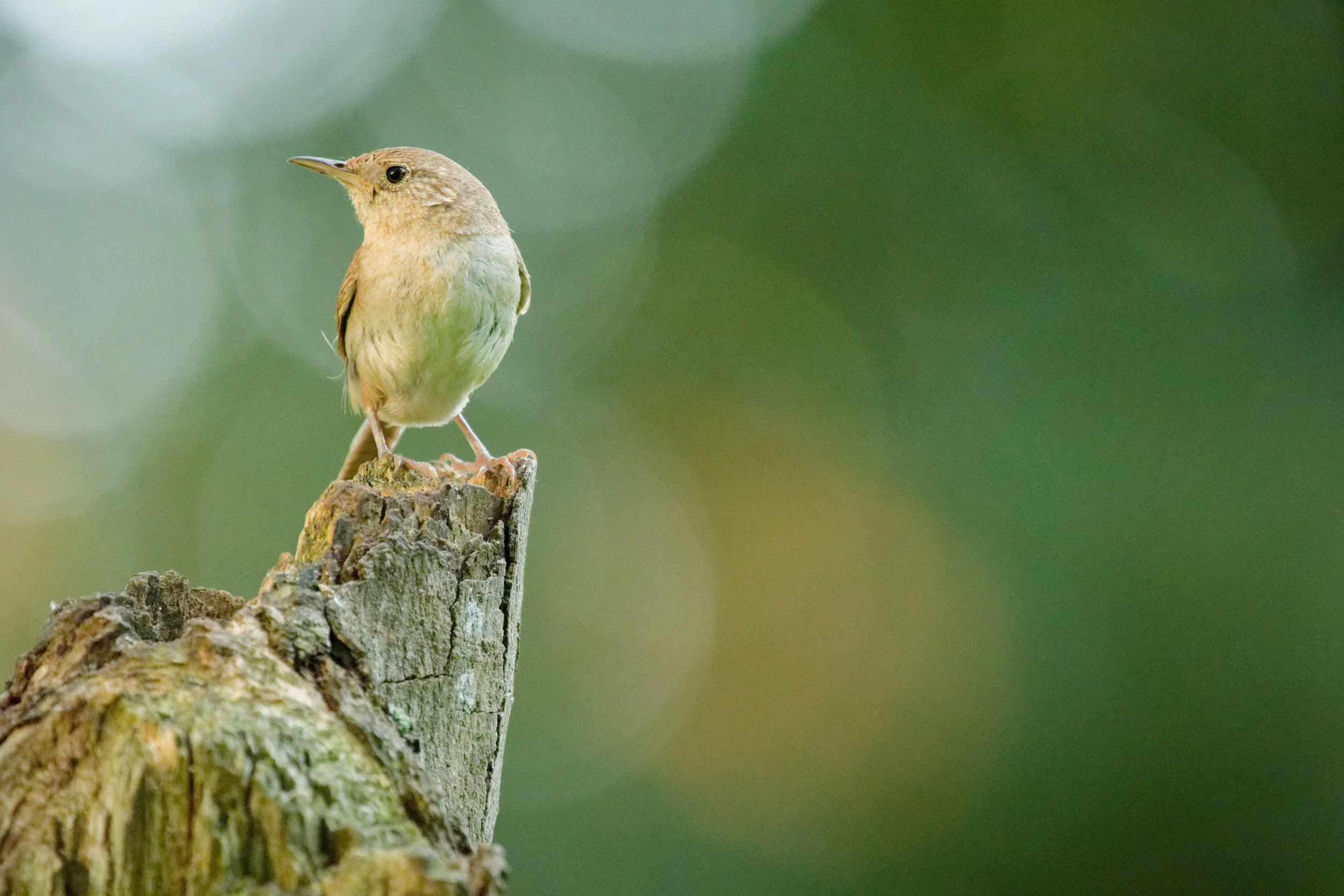
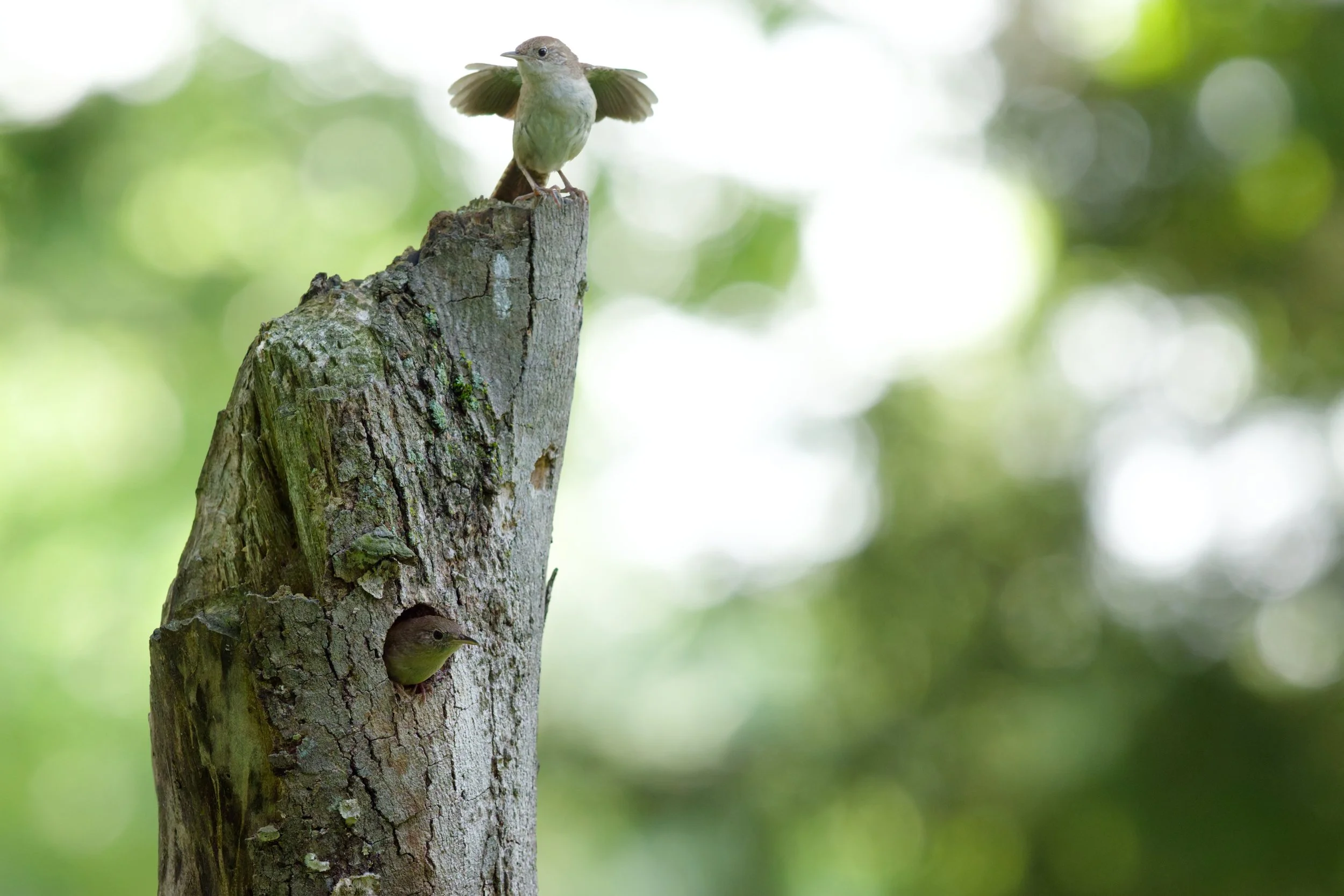
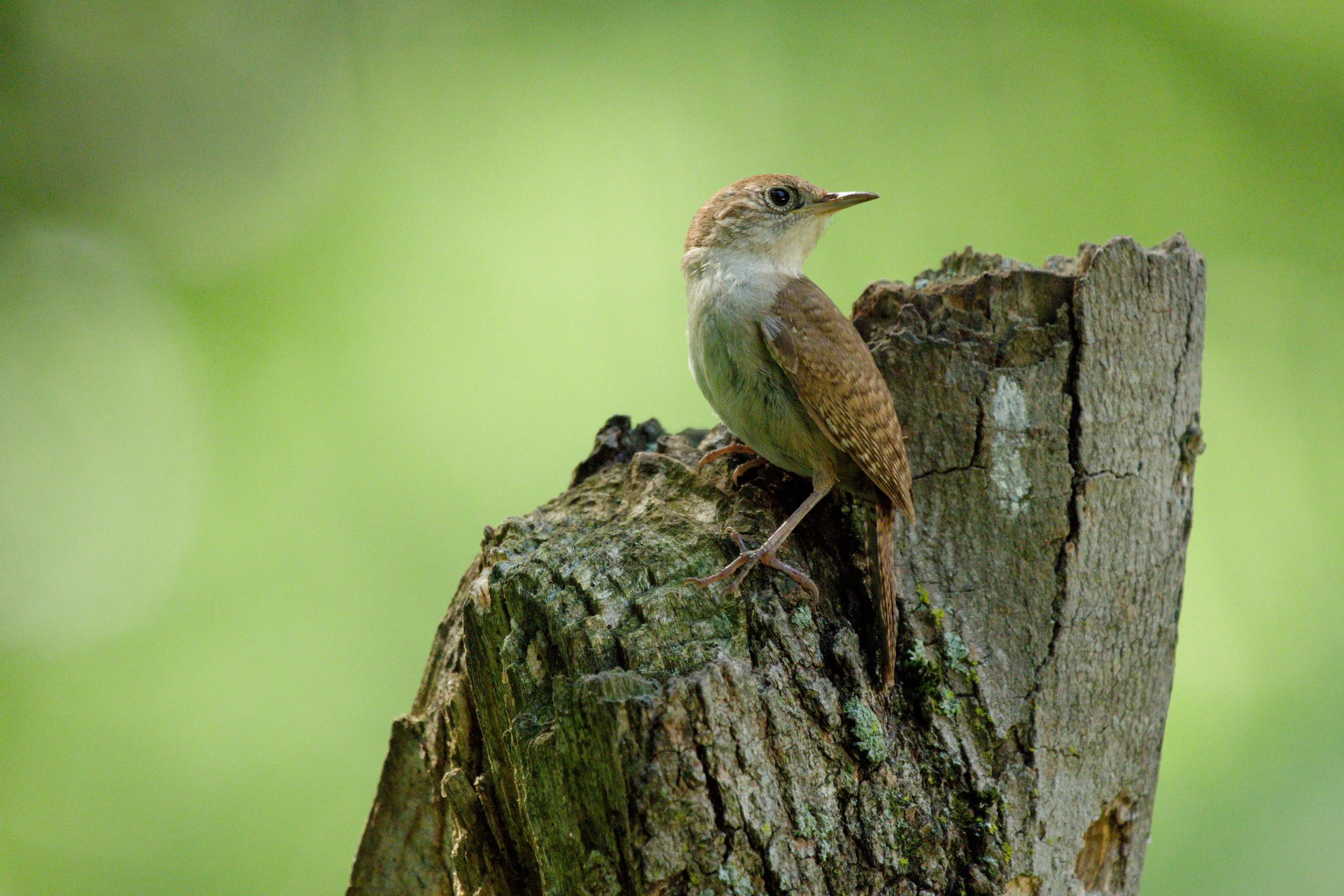
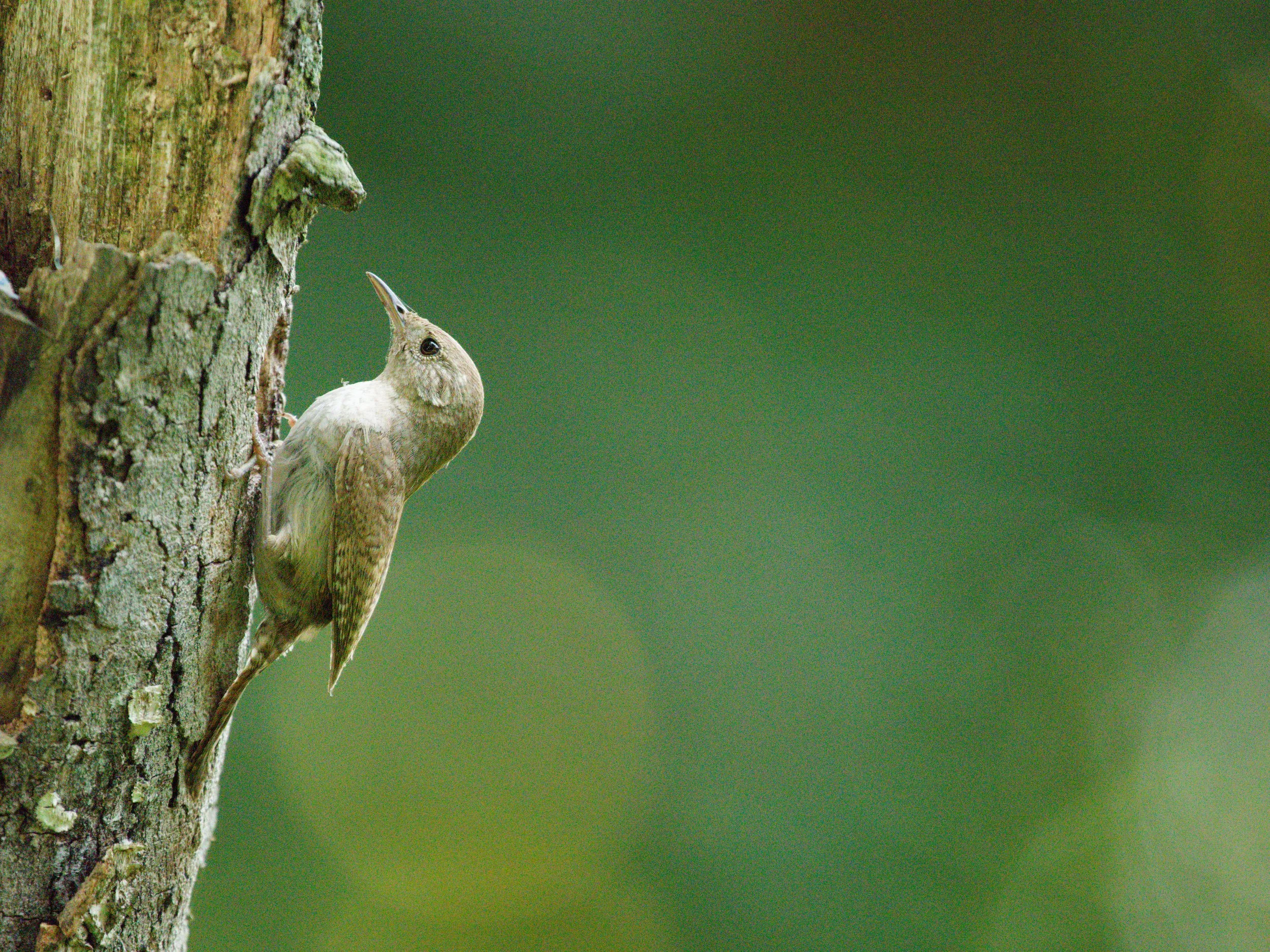
A male Northern House Wren (Troglodytes aedon) takes a momentary break from singing loudly. This male is working to establish his territory in early June.
OM SYSTEM OM-1 Mark II 150-400mm f/4.5 @400mm f/4.5 1/800 ISO 3200
Discovering The Opportunity:
One thing I always strongly advocate for bird photographers is to learn the calls of the birds around you. You don’t need to overwhelm yourself and try to learn all the species, instead focus on the common and year round species that are in your area. This not only gives you a huge sense of enjoyment, knowing what is calling and singing around you, but it can also open up a world of potential photography opportunities.
This is how I recognized a male Northern House Wren (Troglodytes aedon) was active and singing in my backyard. I heard his song long before I ever laid eyes on him. The constant trill and chatter of a wren is always enjoyable to hear, but having one in your own yard is even more exciting. I sat in my backyard trying to pinpoint the areas where he was singing from, and keeping a careful ear to see if I heard the quieter responses of a female.
I watched as the male scoped out the bird house I had made the previous year. He went in and out and sang from the roof but he only tried that for a few days. I continued to hear him singing from the tops of the pitch pine trees that border my property, and I noticed him flying down to the old dead log that I had placed in the ground two years ago. I had put this tree limb in the ground as a perching location for birds in my backyard just to give me a different perch to photograph from. Last year a downy woodpecker had a different idea, and excavated a cavity to raise a family of woodpeckers.
This year the male house wren apparently wanted to take ownership of the cavity. I watch from my office window, the little bird singing his heart out from on top of the tree limb.
I had missed photographing the woodpecker family in the cavity the previous year so this year I wanted to correct that mistake. I set up my photo blind around the tree limb later in the evening when the wren was less active. I positioned it so that I could get decent images of the wren. I planned to adjust the position of the blind once the wren got comfortable with its presence.
My main concern was that I did not want to set up the blind and cause the wren to leave the area. I wanted to set it up farther away, and gradually move it closer.
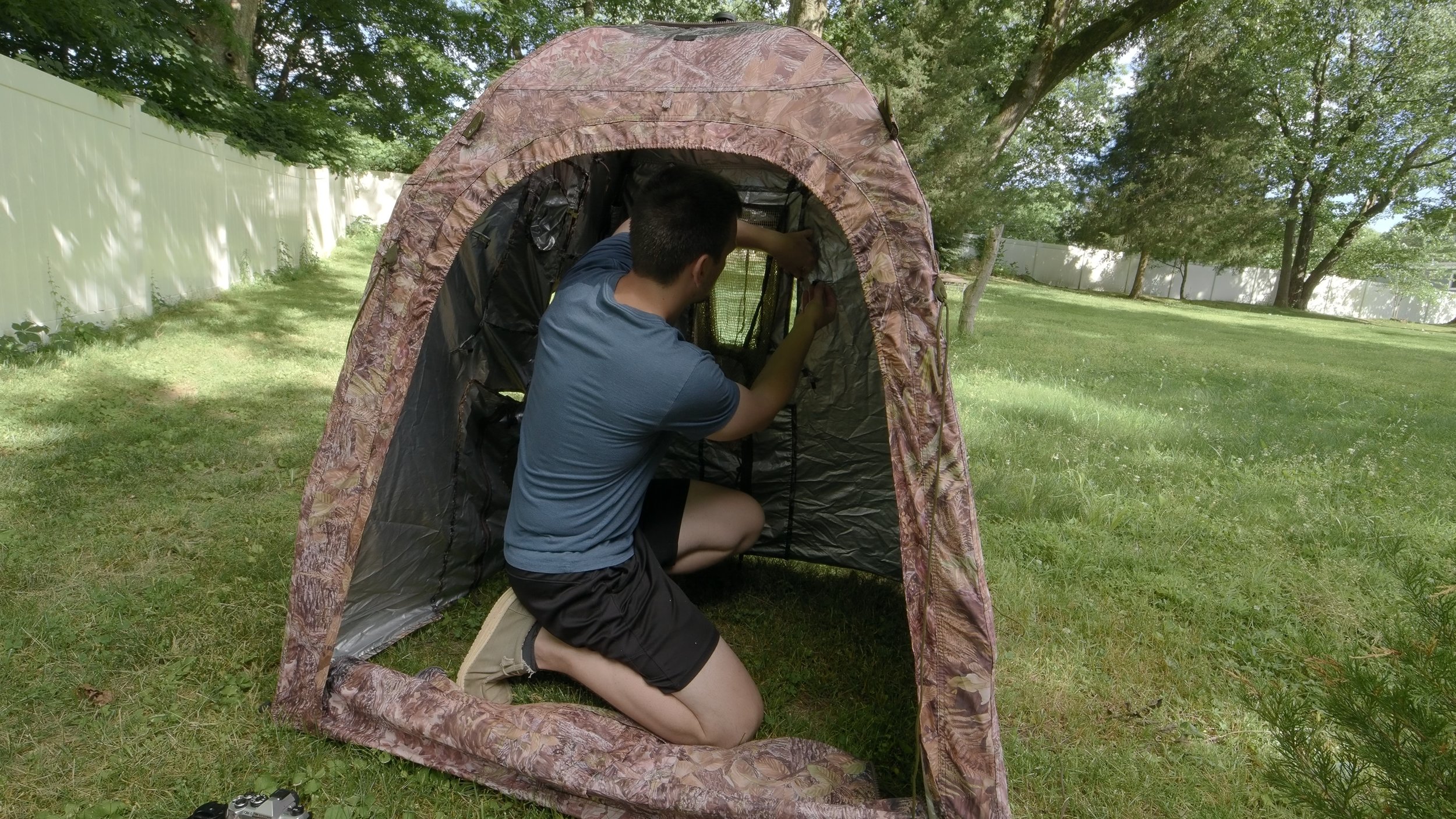
The initial set up of the photo blind. You can see the tree limb and cavity to the right and in front of the blind. The cavity is facing out toward the blind. I waited for the male to be out of the area, then set up the blind quickly and observed how the birds reacted to the new object in their area.
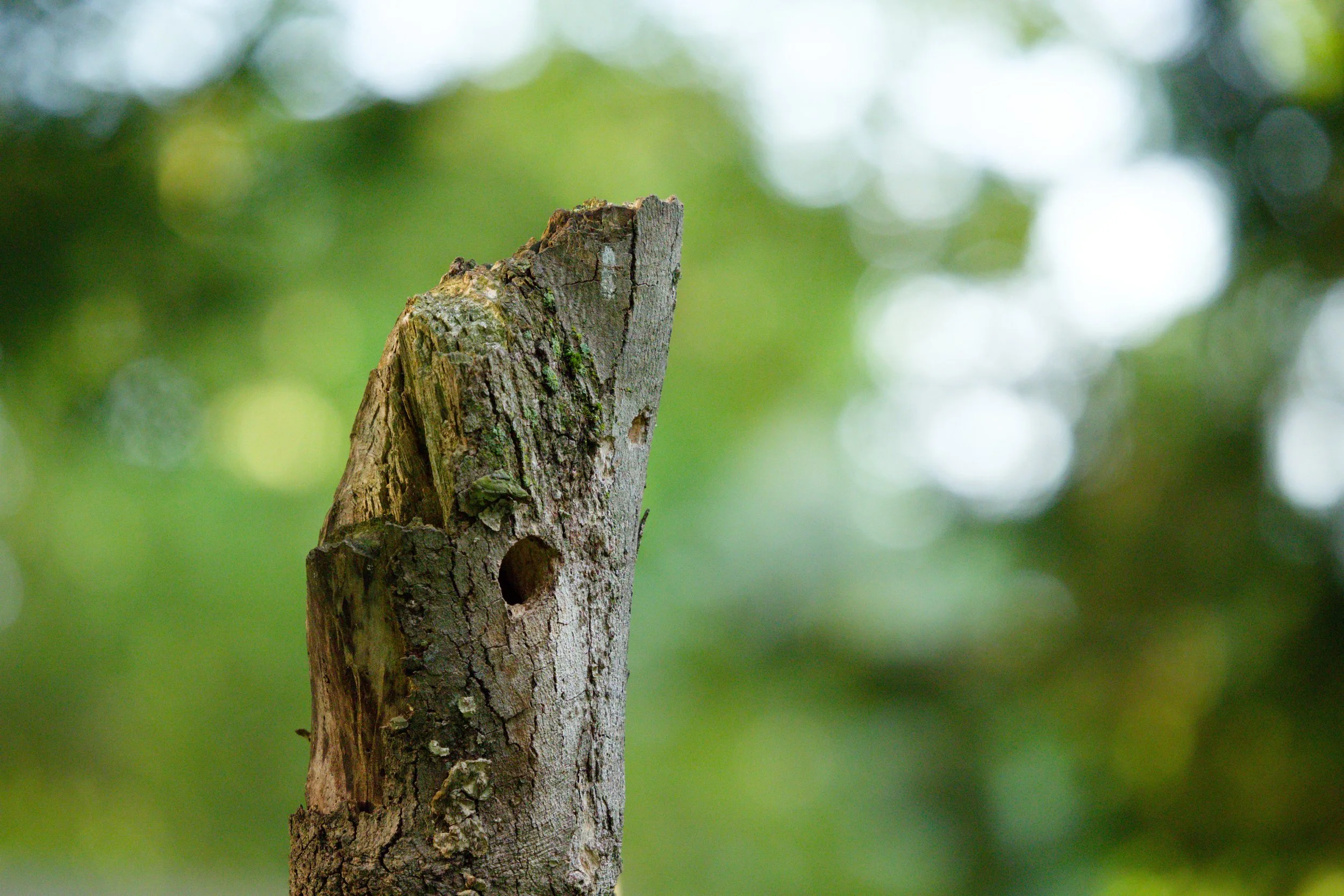
The tree limb and cavity as visible from my initial set up of my photo blind. I located an area where the trees in the background were far enough away to provide a pleasing background. I also was keeping in mind that the wrens are small birds so I wanted to position myself close enough so I would not need to heavily crop the photos.
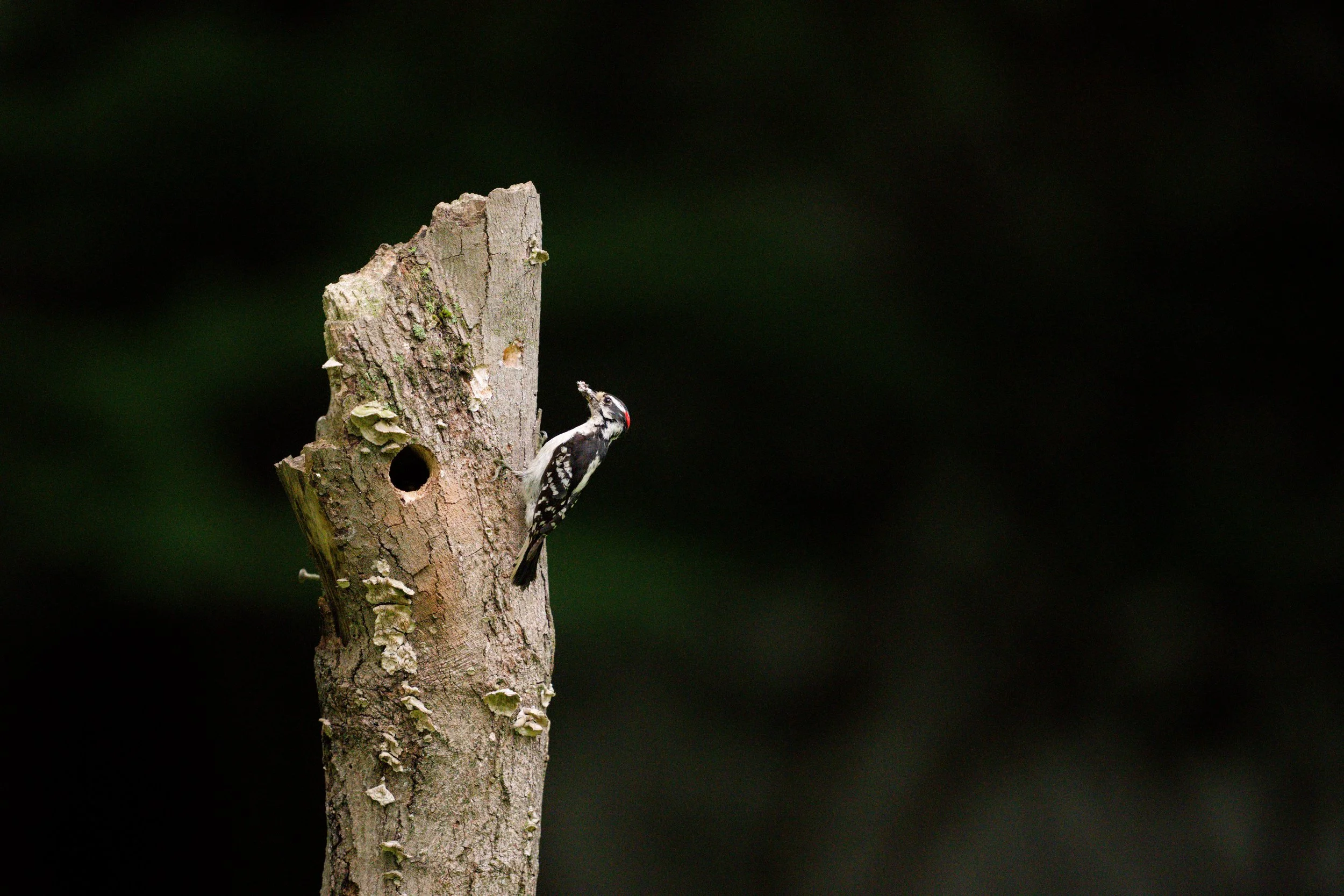
Downy Woodpecker ( Dryobates pubescens) bringing in food to the cavity (2025).
My Expectations:
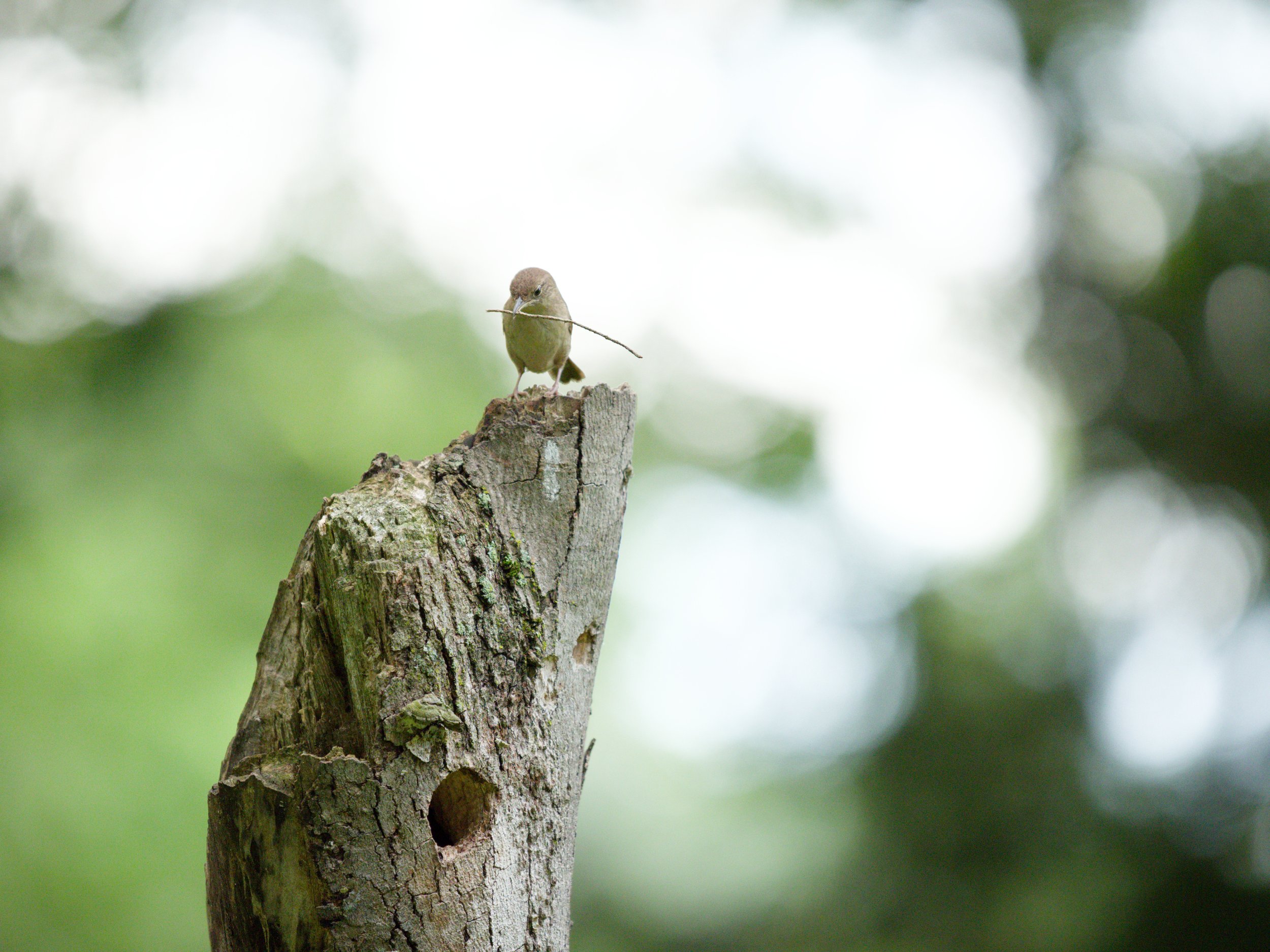
Over the next week, I sat in the yard watching as the male was singing from on top of the limb. Every now and then he would go inside with a twig in his beak. The male house wrens typically build multiple “dummy” nests within their territory and the female eventually chooses which one will be used and completed. At this point I was unsure if this cavity nest where my blind was set up would even be the nest that is used. I have heard the male singing in my neighbors yards as well, so I imagined he had other nesting opportunities elsewhere. I had also not even seen or heard a female in the area. This made me question if the male was even going to have a mate. It was late June when the male had even arrived in my yard, much later than the previous years, and now it was early July and I had not seen a female.
I was beginning to expect that this nest, and this male was not going to be successful this year, so I started to focus on trying to get behavioral shots of the male. The male landing on the limb, the male singing on top, possibly the male entering the cavity with a twig.
I had a chance to set up in the blind on a rainy morning. I love being in the blind when it rains, the drops douncing off the roof, being able to stay dry inside, and having the added layer of having rain in the images always makes it worthwhile.
As I was photographing the male broadcasting his song, I heard the little chatter of a female. I peered through the small side windows of the blind and there on the top of the fence, was a female sitting quietly watching the male singing. I wondered what she was seeing and noticing about this male’s display. Was there a particular part of the song that attracted her, a special characteristic in his plumage, a combination of both. What was she examining about this display?
The male flew off the perch, and soon after the female flew in to take his spot. She looked around and then went into the cavity. She poked her head out every few minutes only to disappear back in the hole. She flew off and the male came right back to the cavity to sing. Soon the male started to chase around the female, which I took as part of the mating ritual for the wrens. To my surprise, during this I saw a second female that came and was watching this all unfold as well. She was perched further down on the fence. I ended up losing track of her as I was trying to follow along with the male and the other female that were busy around the cavity.
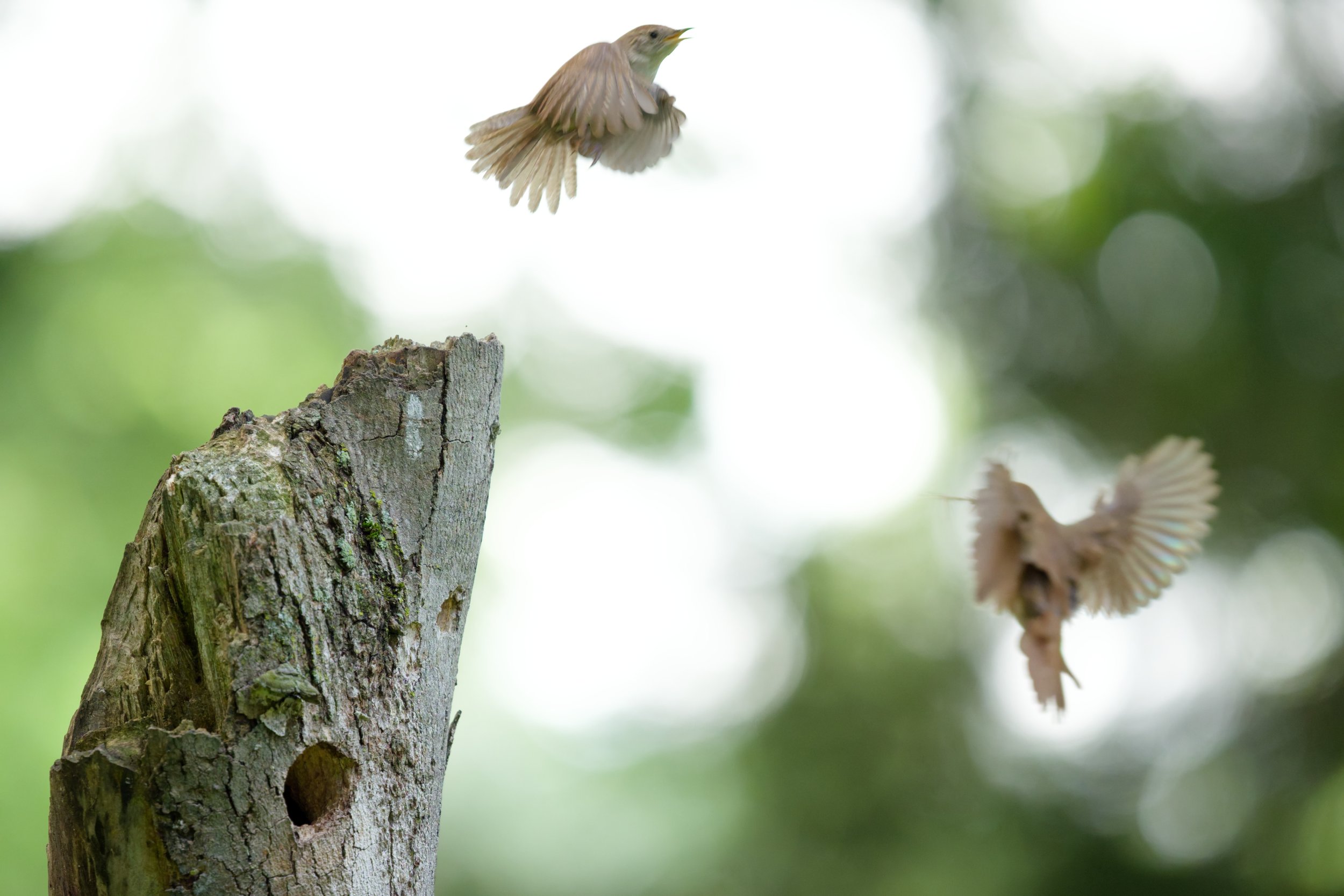
Even though the birds in this image are out of focus, I still think it captures the commotion around the cavity now that the male and female were both there. The female is the bird on the right, bringing in nesting materials. the male was singing on top of the cavity and flew off as the female was flying in. If you look closely you can see a bright greenish blue in the wings of the female wren. This is a really interesting phenomenon that happens when the light passes through the wings of birds. Possibly something to try to capture in a future outing?
This was the moment my expectations changed. I was no longer just trying to get portrait shots of a male wren, now there was the opportunity to get all kinds of behavior shots of the nest building process, feeding young, fledging, all things I have never seen before with this species.
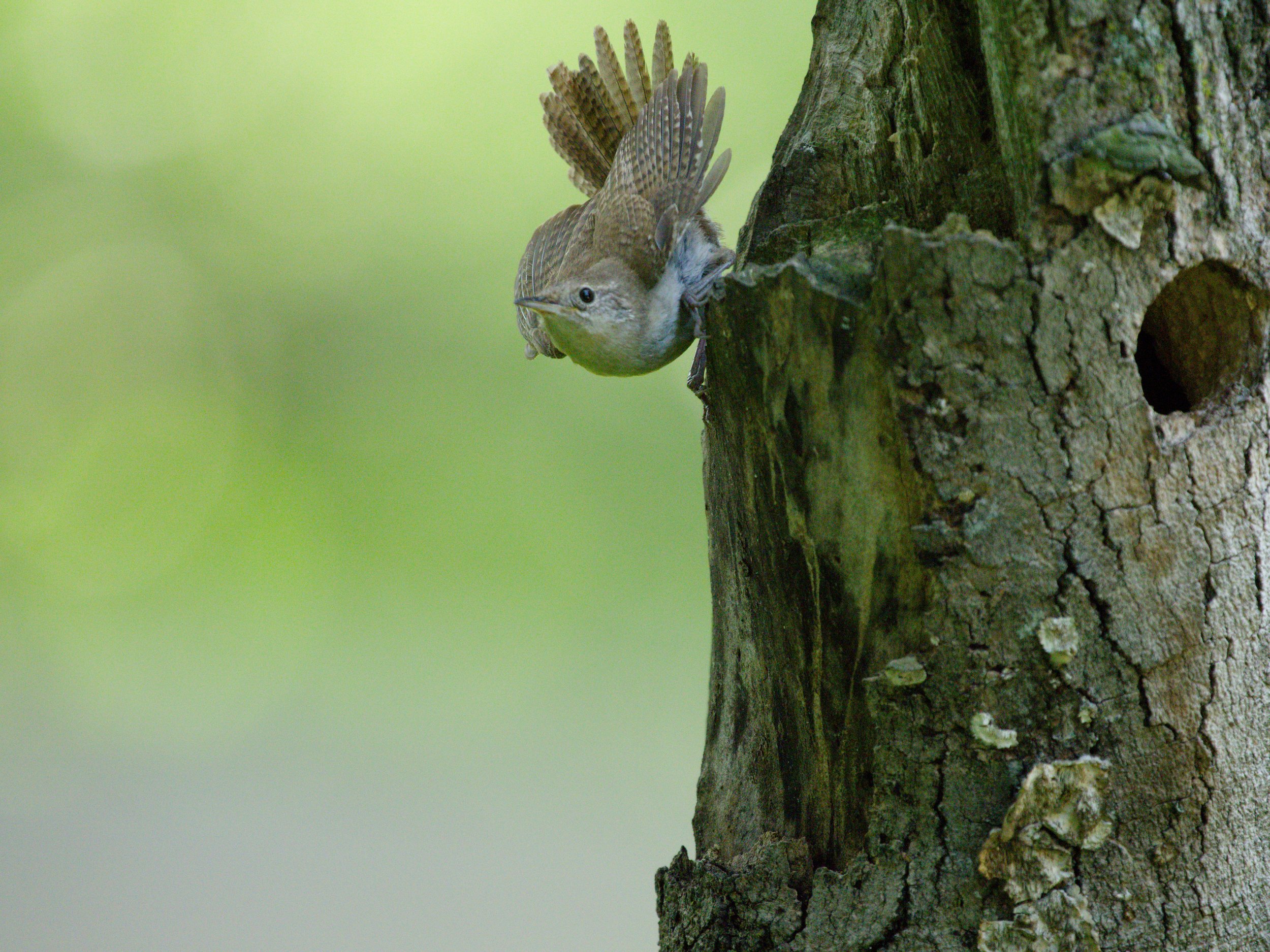
I was also thinking about how this new behavior would influence my photography. Right now, the blind was set up so I could see into the cavity. This made it difficult to get flight shots of the birds flying into or out of the cavity because the background was slightly distracting and the birds were flying on an angle from me. If I wanted to try to get that shot, I would likely need to change where I was positioned.
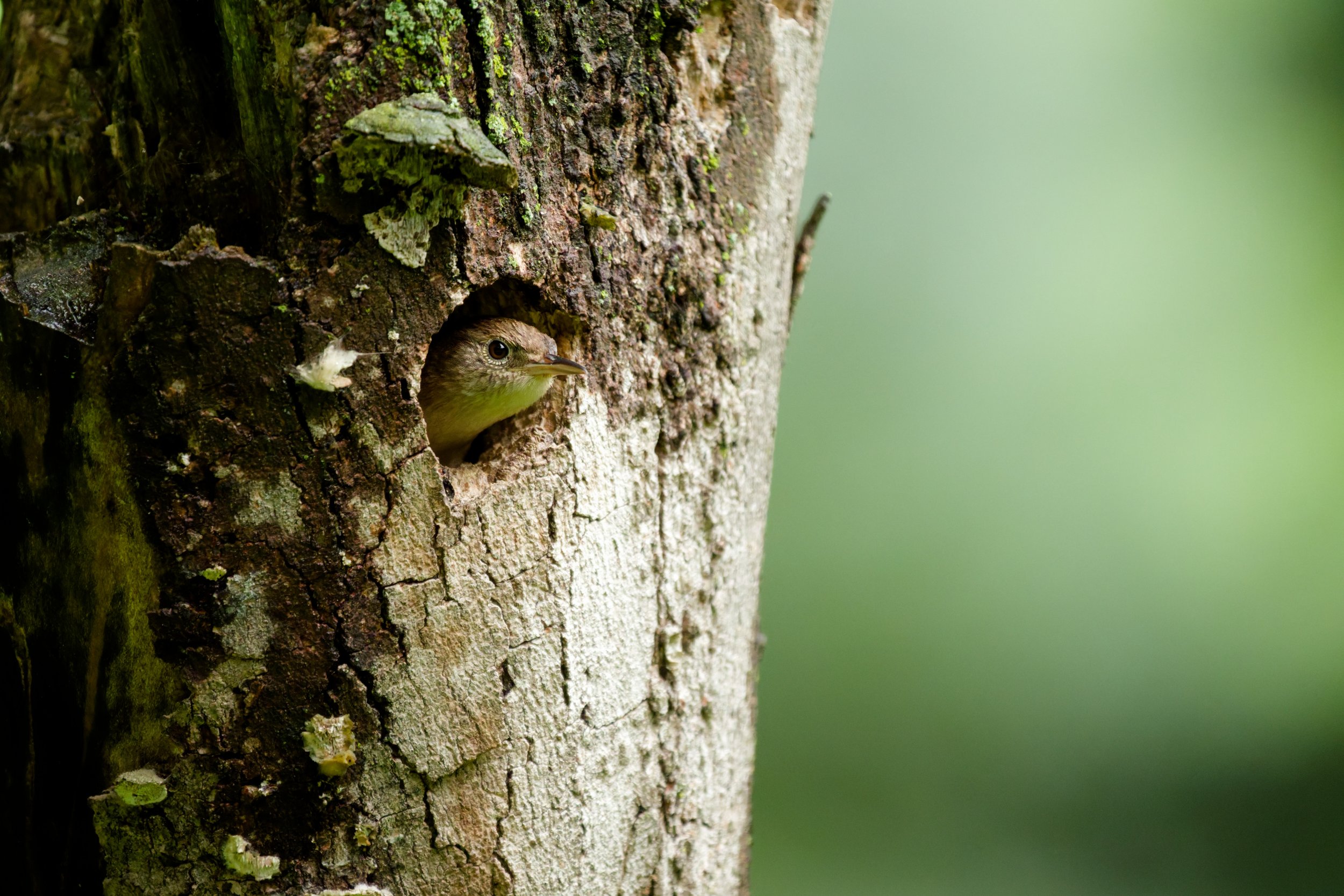
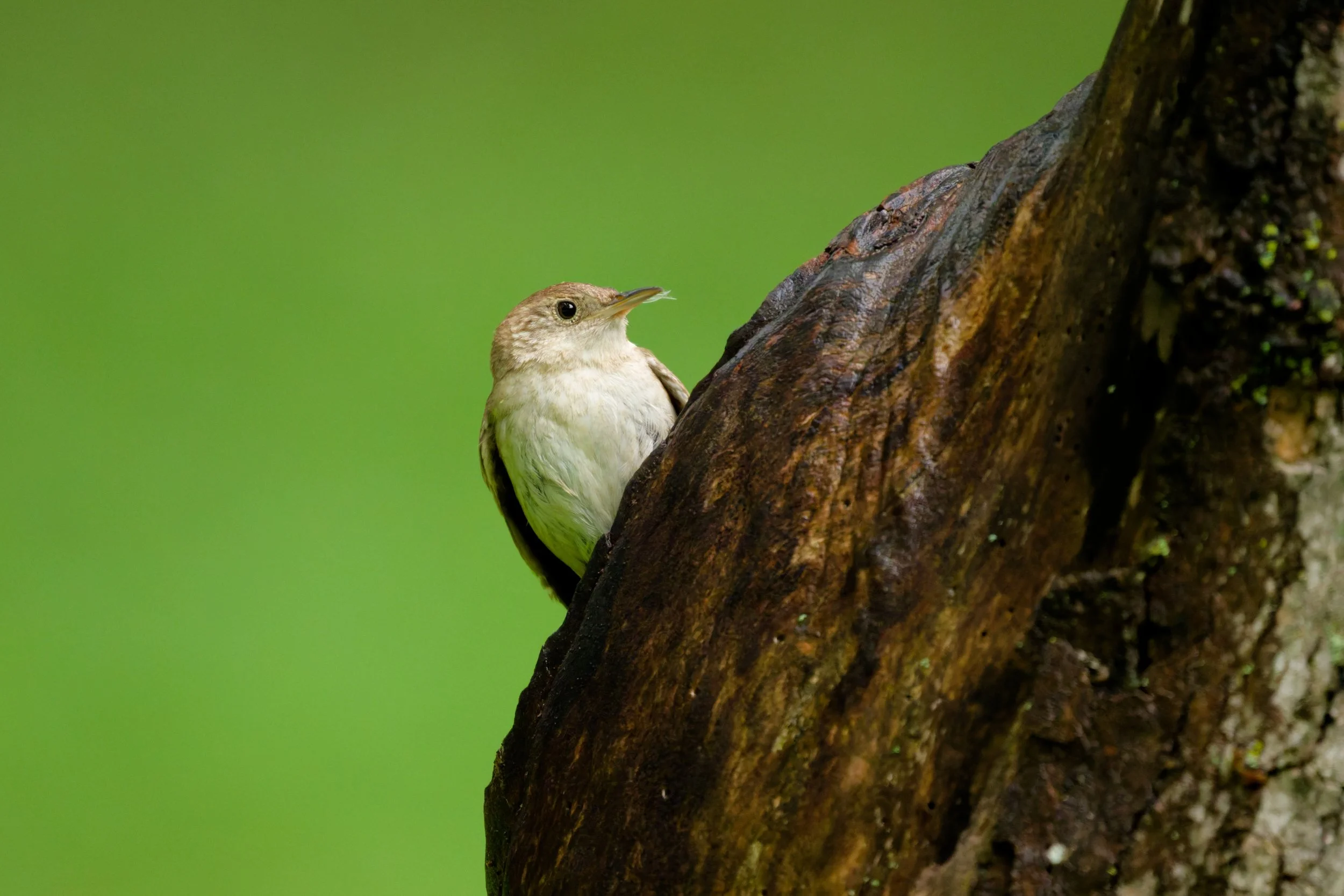
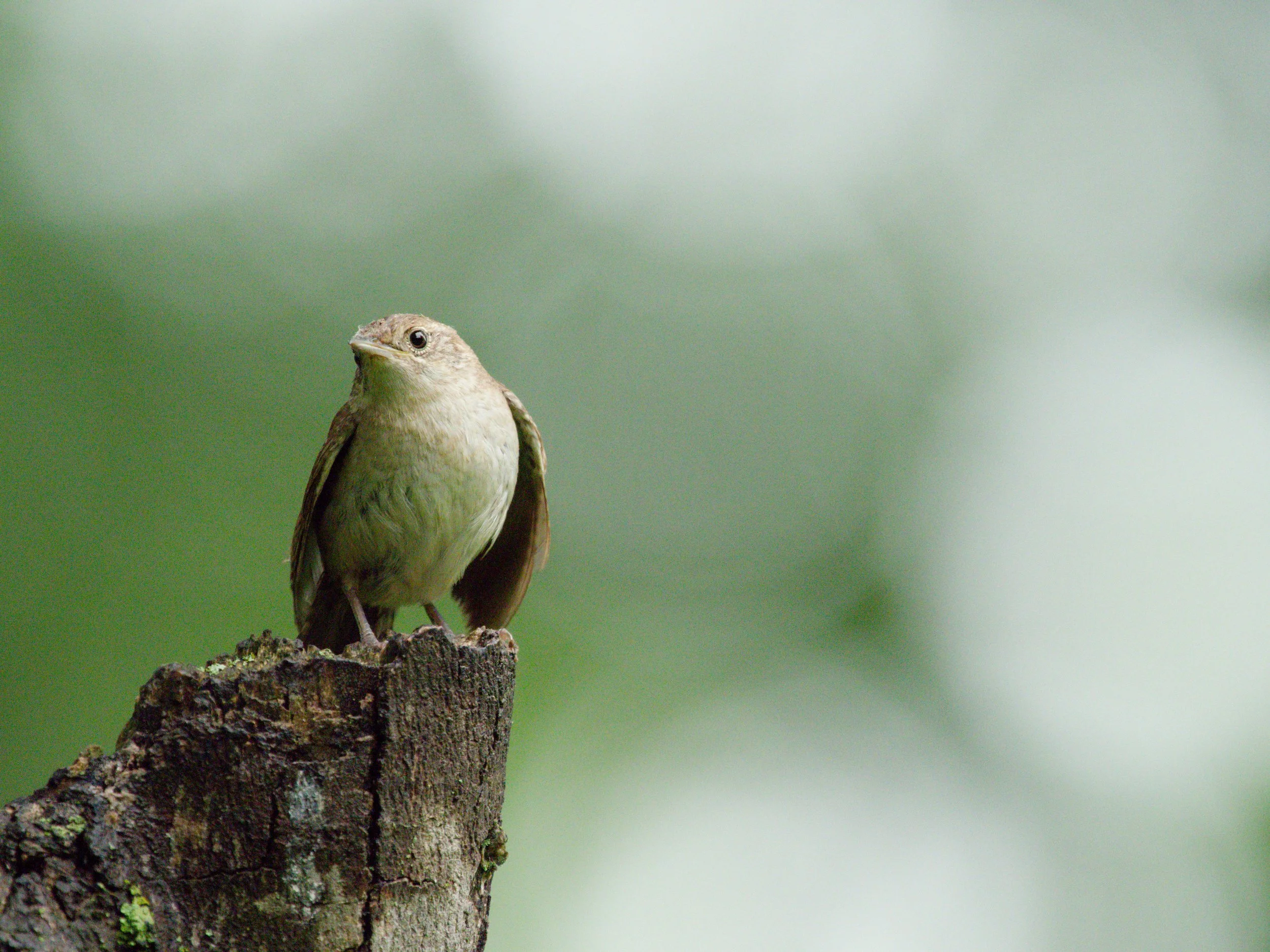
House wren poking their head out of the cavity. This was from the initial location of the blind. I am positioned on a slight angle to the cavity. This Mae it difficult to capture the birds flying in and out of the cavity.
I was also thinking about the background and lighting. Where I was, the background again was a little distracting. There was a mixture of sky and leaves a decent distance away but it distracted from the birds. Also the light was coming in from an angle. The sunrise was behind and slightly to the left, which created some nice backlit opportunities but didn’t allow for me to get much detail/light on the feathers of the birds. The tree limb was placed in a section of the yard that was mostly in the shade, so light was low especially in the early morning when the wrens were most active.
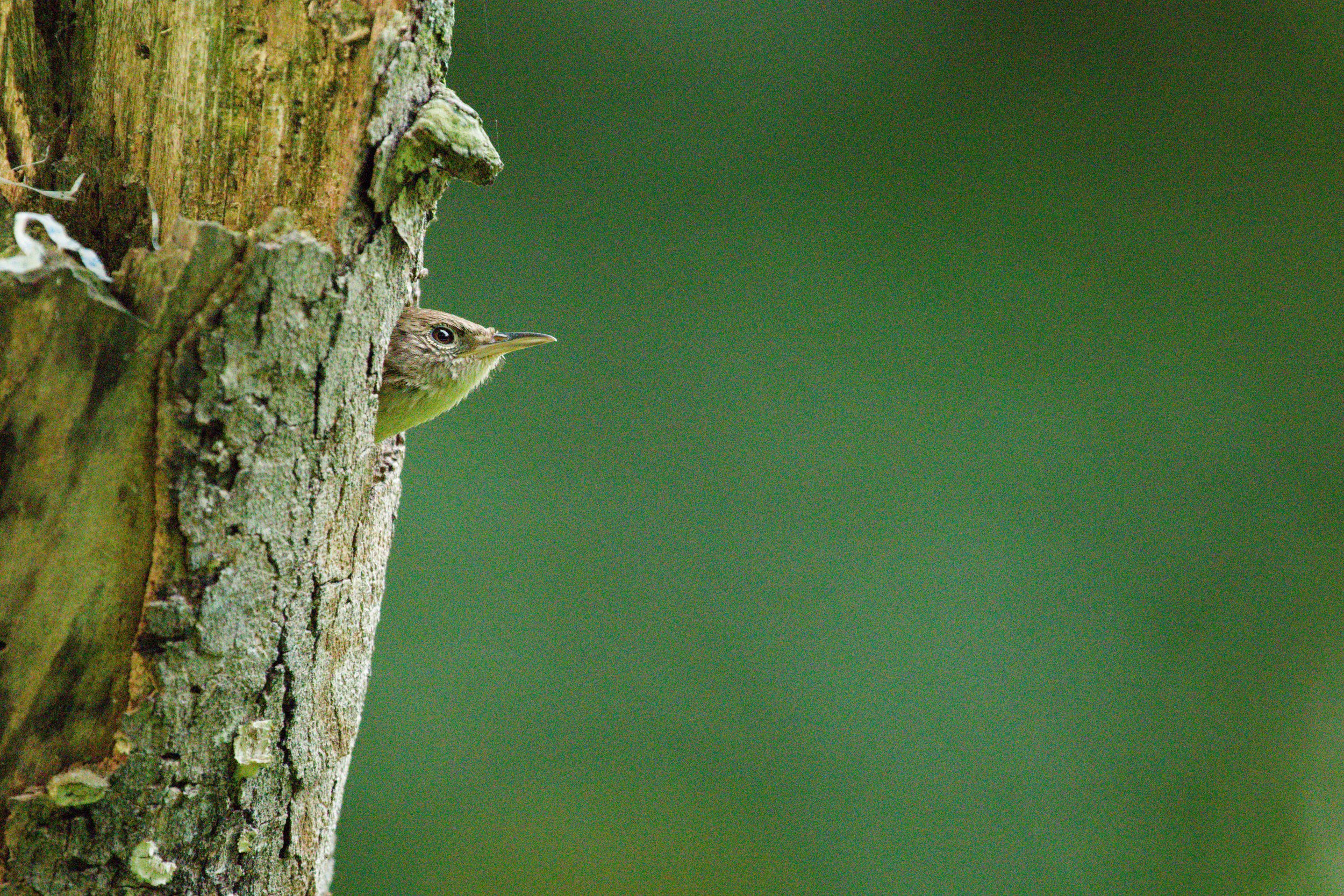
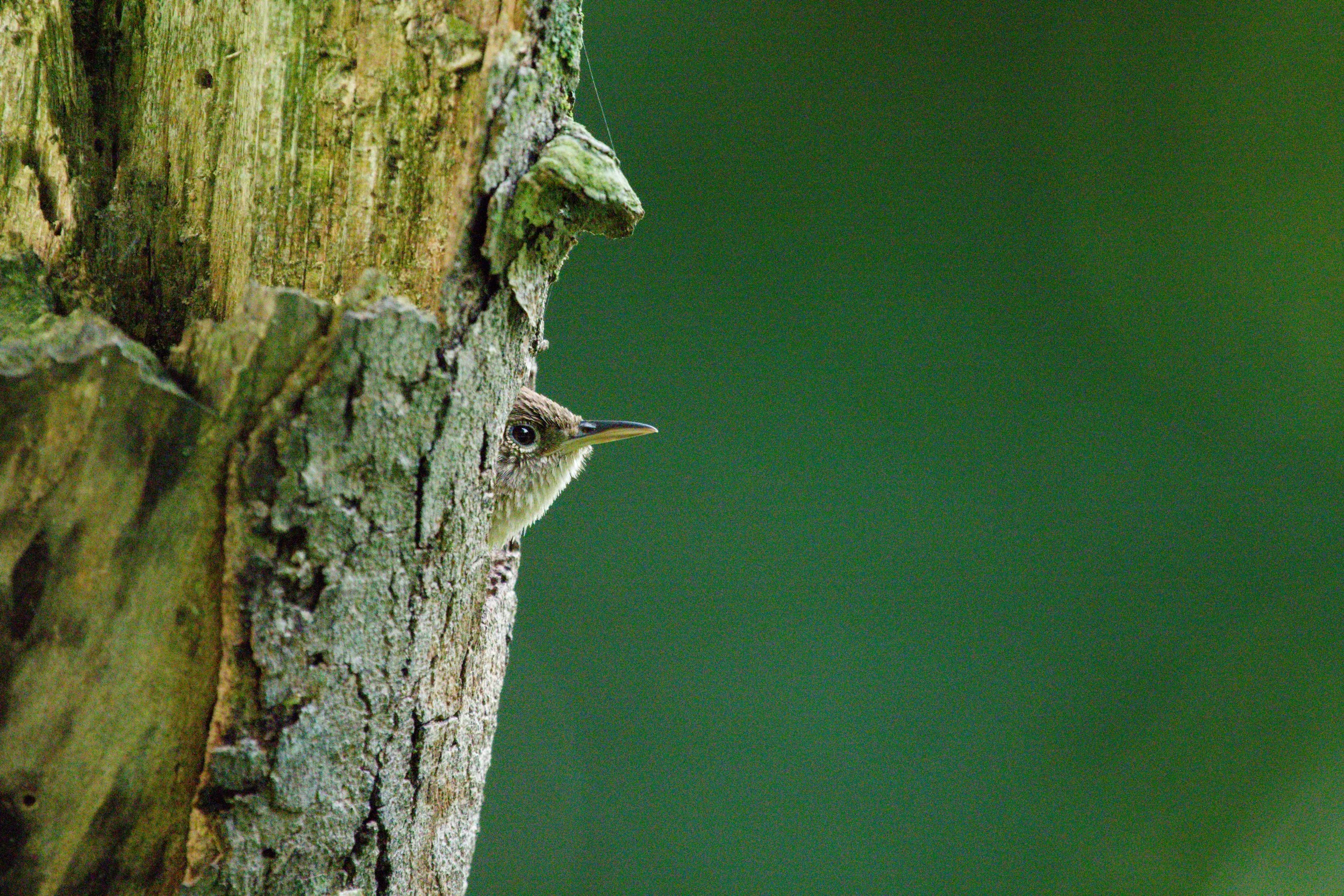
House Wren poking their head out from the second blind location. I positioned it so I was now parallel with the cavity making it easier to catch the birds flying in and out of the cavity. It also created a unique composition making the wrens head really stand out as they surveyed the area around the nest.
I planned out where I could reposition the blind to get a side profile of the cavity, and also have a little better lighting and background opportunities. It was about 15 feet to the left. I was also comfortable moving the blind slightly closer to the cavity now that the blind had been set up for a few weeks now. The wrens were so comfortable with it that the male was actually using the point in the roof to sing from! I repositioned the blind at dusk when the birds were least active and let it sit without me entering it for a few days to see how the birds reacted to the change.
Over the Next Month:
There are numerous benefits of photographing the same species, let alone the same animals on multiple occasions.
I learned to recognize patterns of behavior that would otherwise go unnoticed or be perceived as random/chance behaviors. One such common occurrence was that the birds would often become vocal just before they flew in to land on the perch and just before they flew off. This allowed me to have a decent chance of getting ready to capture that, once I heard them calling.
I also became familiar with favorite perches that the male would sing from around the cavity. The male would also often fly to the cavity from one of these perches so I could keep an eye on him.
I was also able to witness other interesting behavior such as the interaction with other species. On a few occasions a downy woodpecker came over to the cavity. The wrens didn’t appreciate this visitor so they tried their best to move them along. I couldn't help but wonder if this downy was one of the adults or young from last year who raised some chicks in this very cavity.
It was funny to see the wren, such a small bird, take on the larger woodpecker.
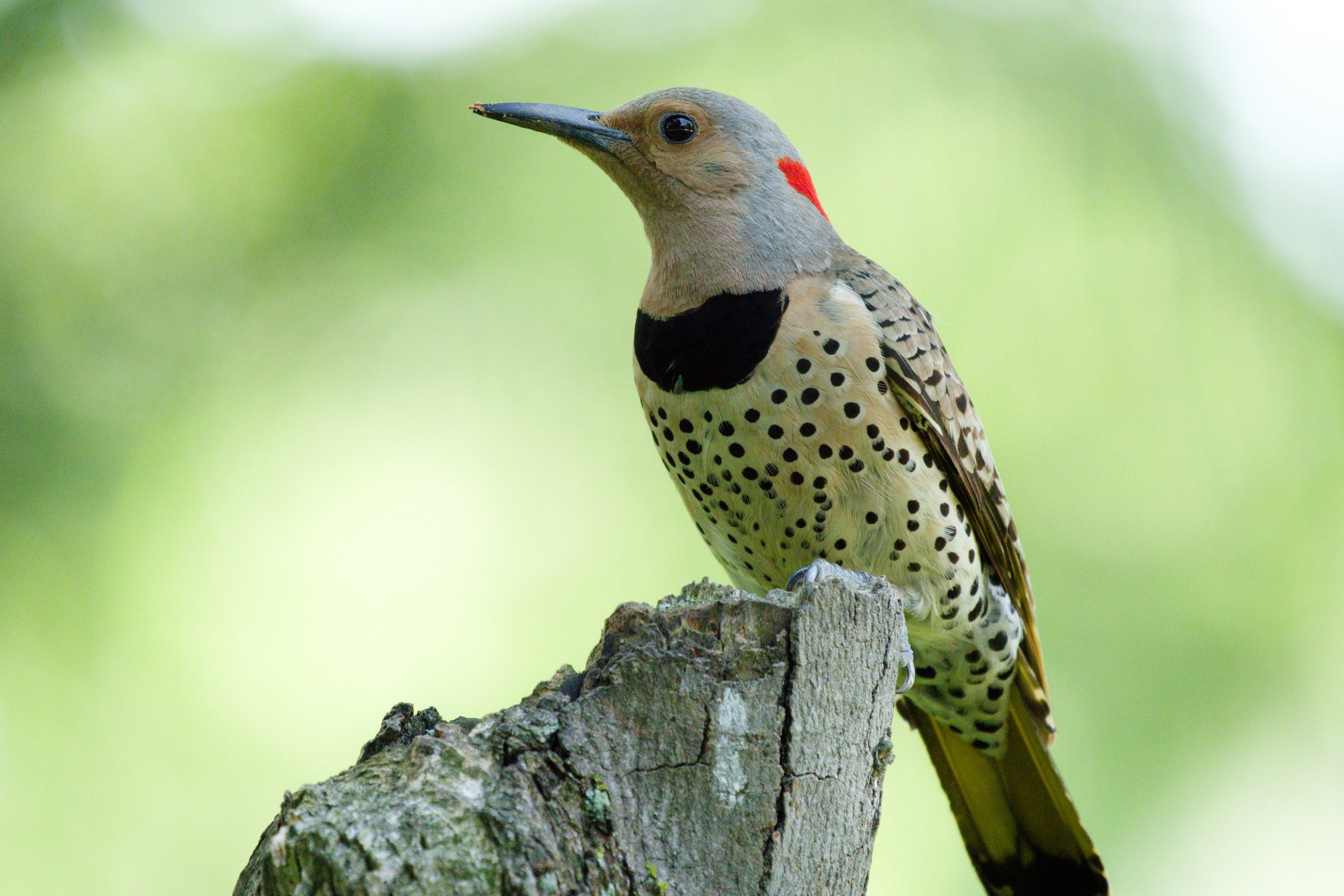
On multiple occasions the cavity was also visited by a Northern Flicker. The wrens were not happy about this at all and seeing the wrens try their best to chase off this much larger bird was a little commercial and you couldn't help but feel sorry for the wrens. Luckily the flicker did not do any real harm to the wrens or the cavity, and instead appeared to be using the tree limb simply as a place to sit and look around. The flicker did visit on multiple occasions though and on most of the interactions it was the female house wren that ended up chasing away the flicker for good.
I watched the birds bringing twigs to the nest, trying to maneuver larger twigs into the small cavity and getting creative in their attempts to get them to fit.
While I could not be certain when the pair laid eggs, I could be sure when at least one of the eggs had hatched. This was because the adults started to carry away fecal sacs from the young. This is a rather unpleasant but necessary thing that adult birds raising young must do to keep the nest clean. Think of it as changing a diaper!
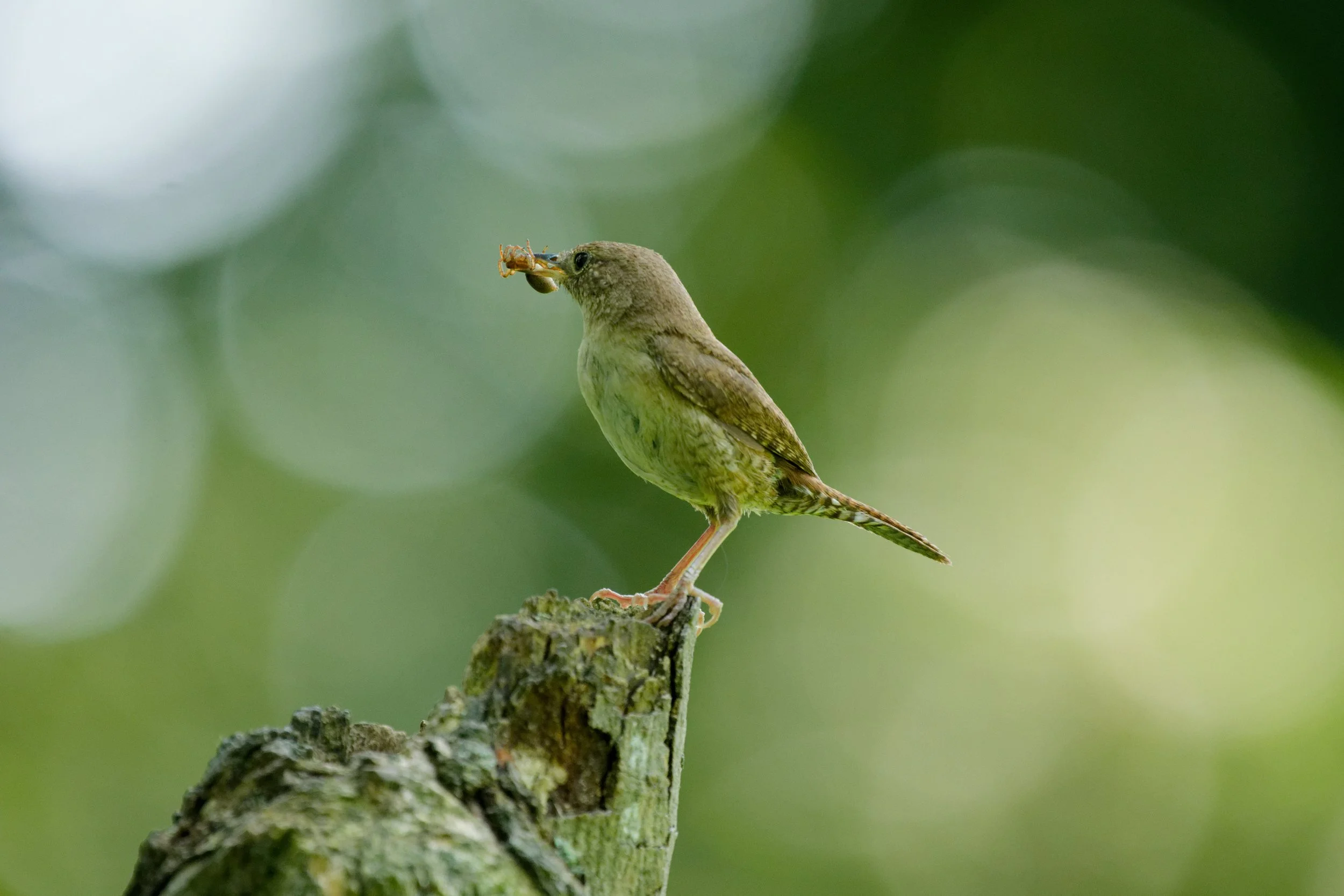
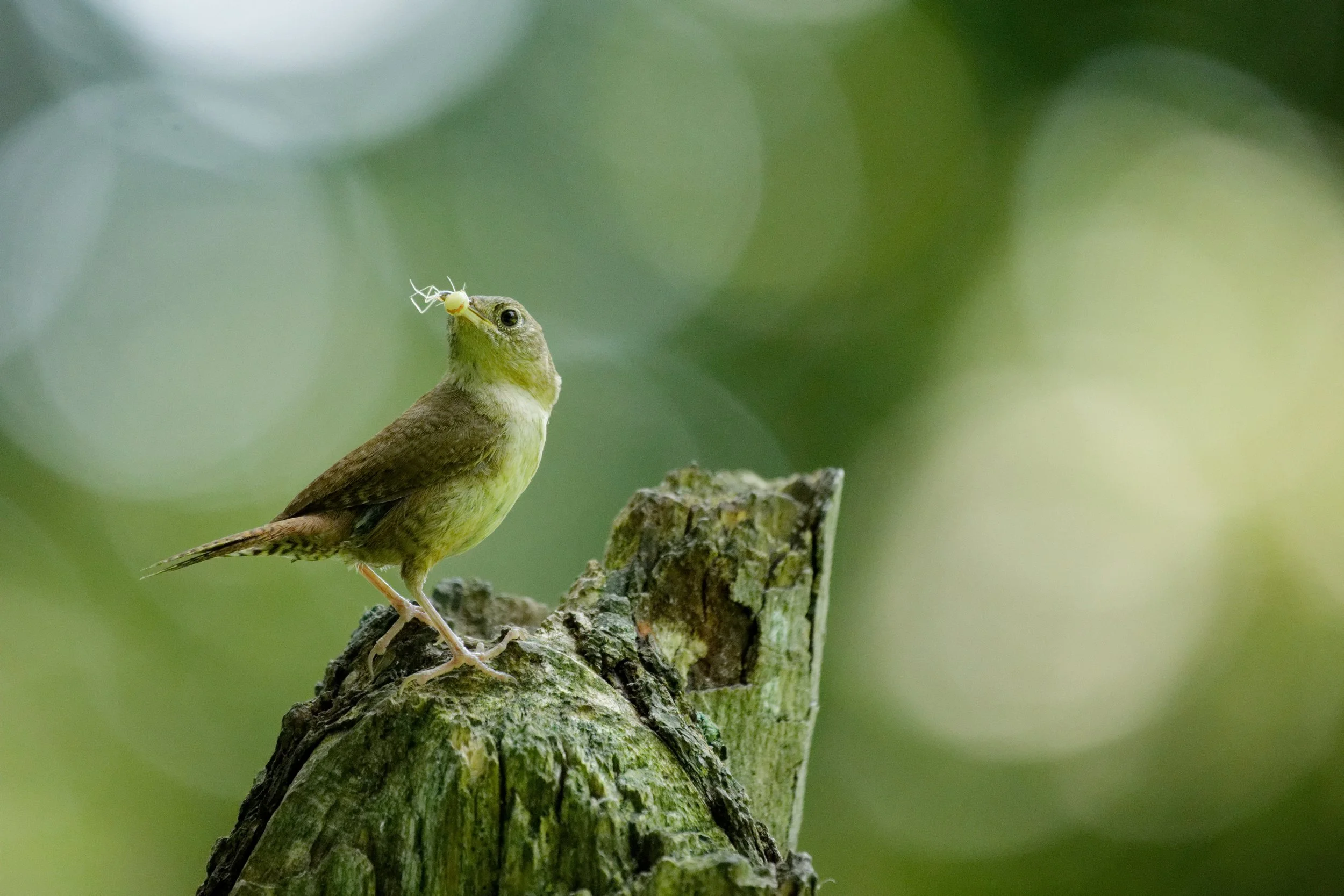
Some other interesting observations were the kinds of food that were being brought into the young. The wrens seemed to specialize in bringing in spiders of all kinds to the cavity. There was also the odd caterpillar and other insects I could not identify, but most were spiders. This was interesting and also made sense with how the wrens forage in the brush. They are often lower to the ground and in the dense brush, perfect places to find spiders.
I also was able to observe the frequency of these feedings, occurring roughly every 10 minutes or so. I could not always tell if it was the male or female bringing in the food, since once the female arrived and there was young in the cavity, the male stopped singing altogether except for the occasional early morning song. The most activity was after sunrise until about 10 in the morning.
With all this time spent watching these birds, I was able to get a really good sense of their patterns and behaviors. The best way to keep track of all this is to keep notes of the behavior.
These notes are not only relevant for house wrens, many birds operate in the same fashion. The information that I observed with these wrens can and will be used when observing other species around their nests.
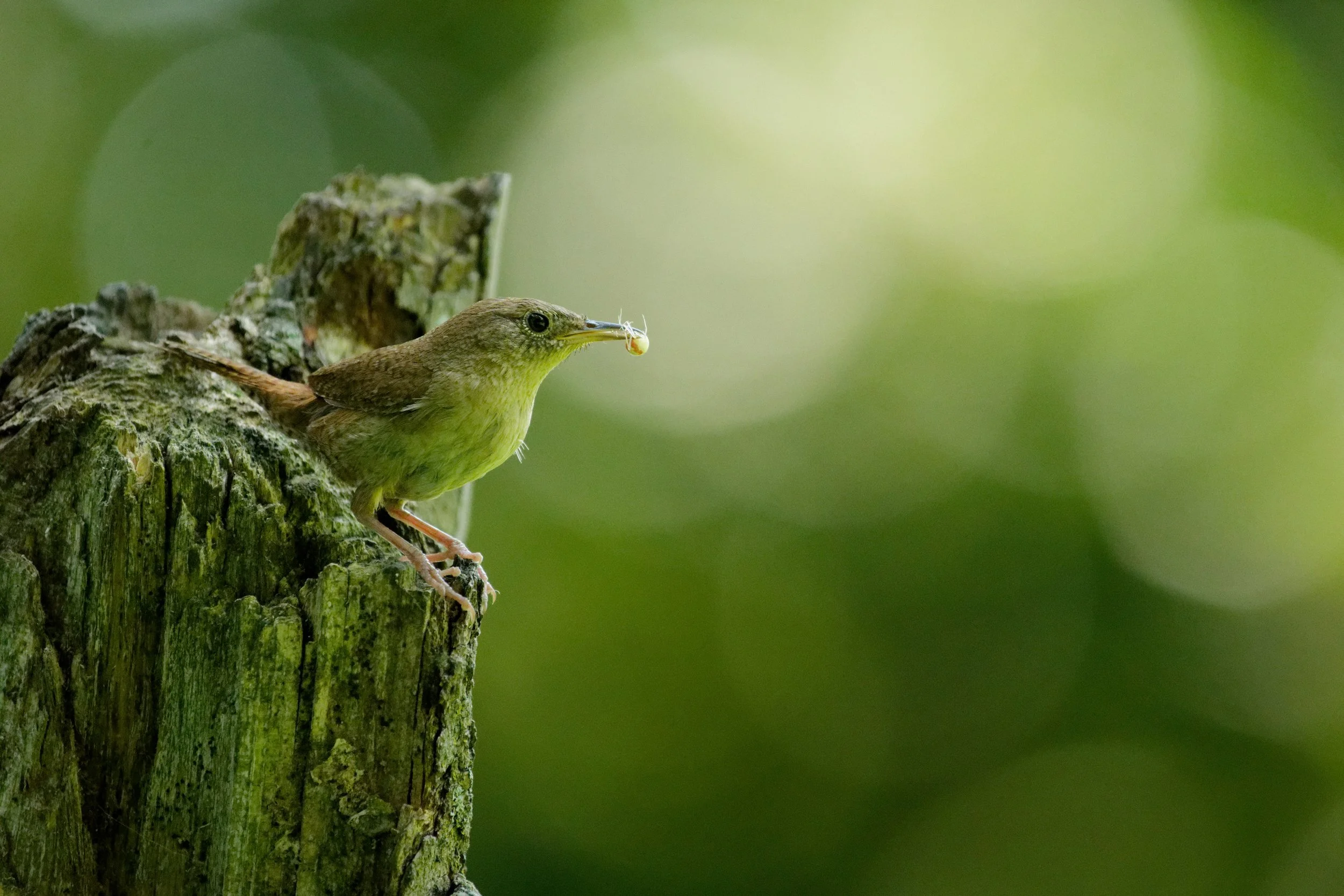
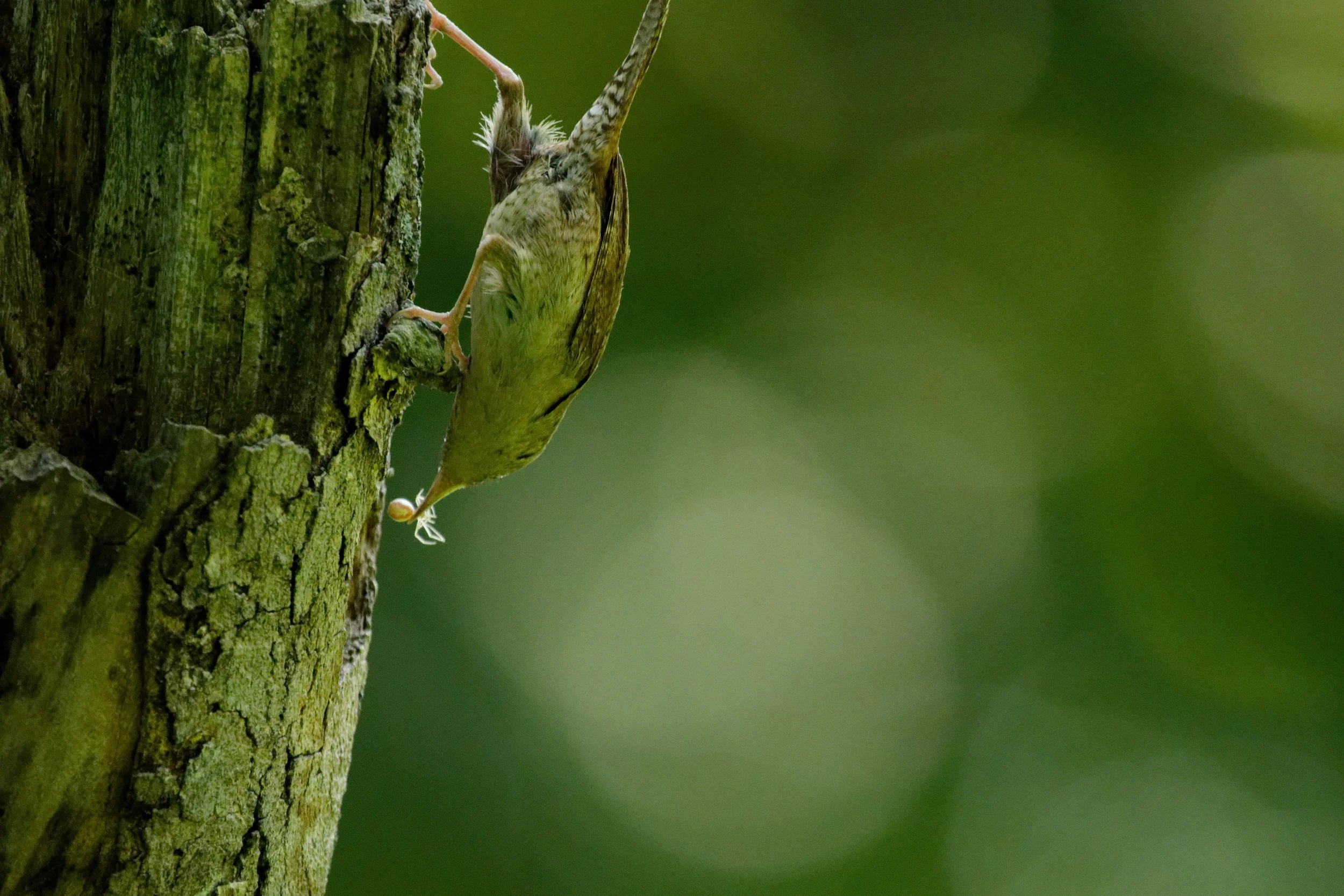
What Changed:
The most striking thing that I observed was how the behavior of the birds changed during the month that I photographed and observed them.
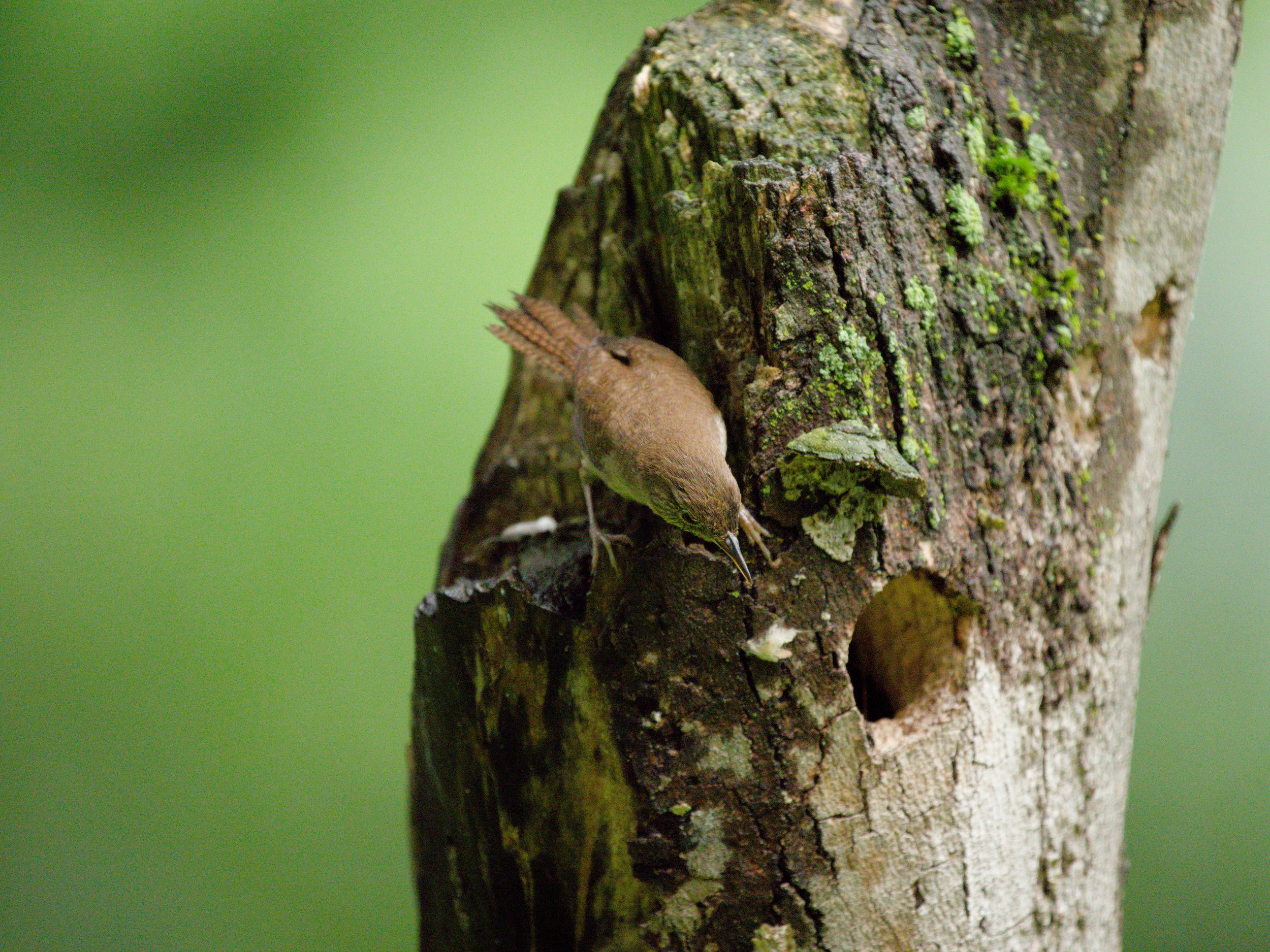
The behavior of the male was what changed the most. He started singing loudly almost nonstop everyday until the day the female showed up. Once the female showed up his motivation and behavior shifted from needing to attract a mate, to needing to help build the nest and provide for the female. Before the eggs were even laid, the male would bring insects to the cavity, sometimes with the female in the cavity and other times when she was out getting nesting materials. It was as if he was practicing. Most of the time he would simply eat the insect himself on top of the cavity.
The activity around the cavity also changed once the eggs and young had hatched. There was even less calling around the cavity when the eggs had hatched. The frequency of visits to the nest increased as the young were getting ready to fledge.
Another struggle was that as the young grew in the cavity, the “warning” calls that occurred before the adults would visit the cavity no longer occurred. This meant that I no longer had any warning before the adults would visit the nest making it much more difficult to capture sequences of the birds flying and leaving the nest.
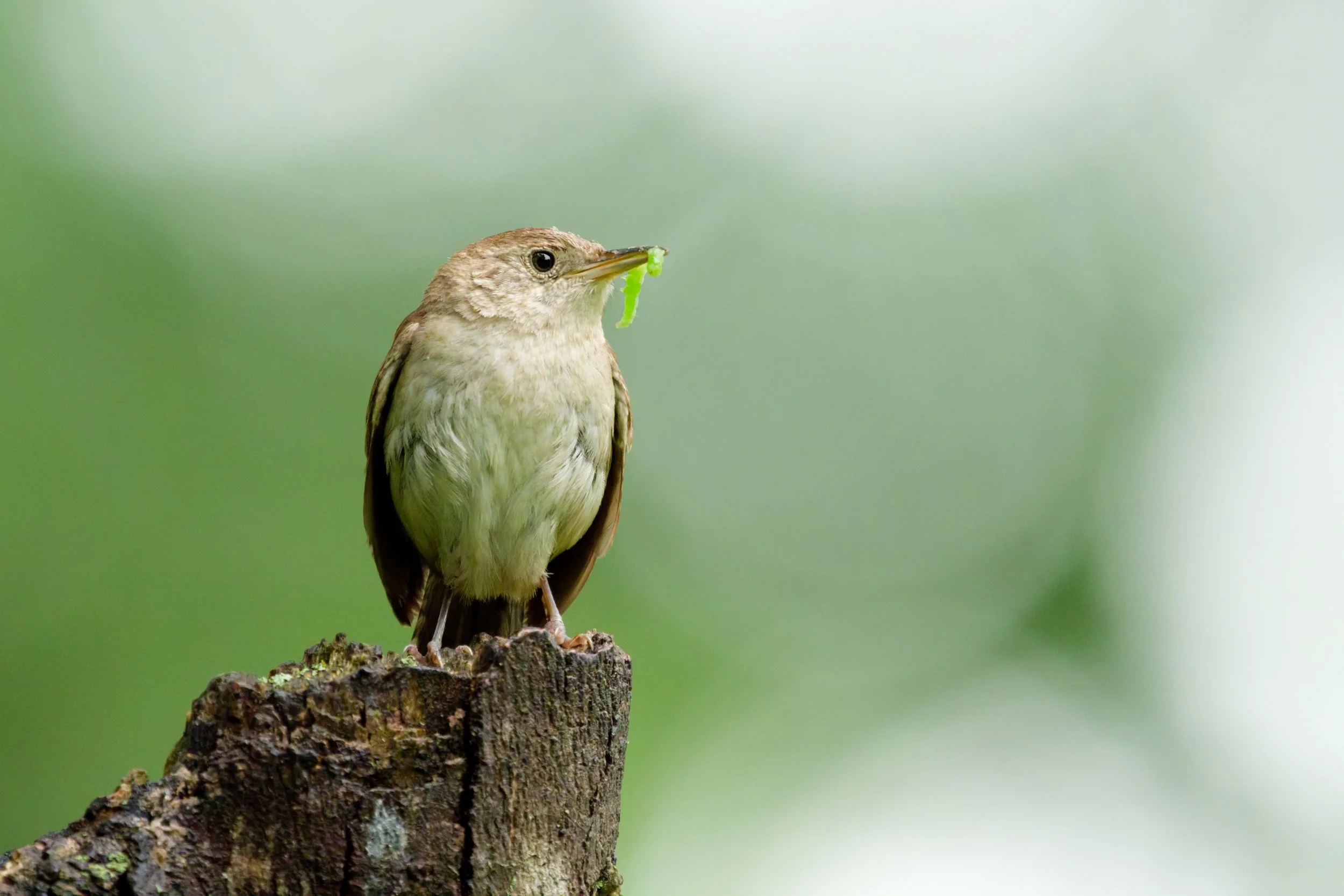
Male house wren with a caterpillar in his mouth. The female was in the cavity and the male ended up eating the caterpillar himself rather than providing it to the female. This was before the nest was created.
What I Missed:
This opportunity taught me so much about the birds, photography, patience and practice.
The most striking thing that comes to mind of what I missed was the opportunity to photograph the young fledging from the nest. I was away on vacation during the last week or so when the birds were in the cavity. Upon my return, I was glad to see that there was still activity around the cavity, and I planned to sit in the blind to try to get the young fledging the following day. A little research about the birds indicated that they should fledge any day now. As nature would have it, by the time I set up in the blind, I was a day late. The previous morning the young had fledged, and the adults left as well. The backyard was quiet and there was no sign of the wren family anywhere. This was a huge missed opportunity. The lesson here being that as the timeframe for fledging approaches, it is best to try to get as much time around the cavity as possible to try to capture the fledging.
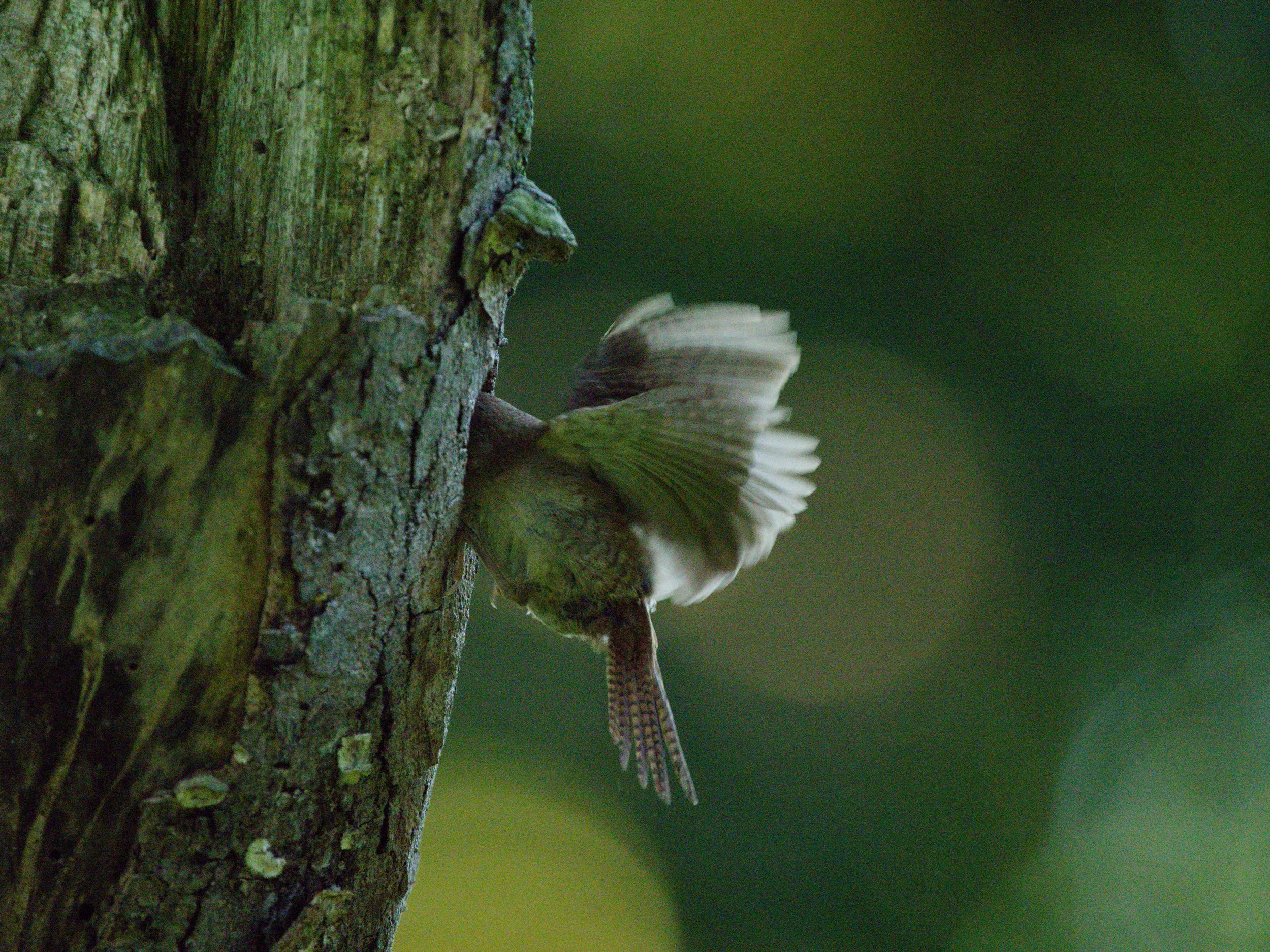
Another missed opportunity was the birds flying in and out of the cavity. I was able to get some different and interesting behavioral shots of the birds on and around the cavity but I did not capture the image I had in mind of a wren flying into the cavity. I got an image that was close, but the wren was still very blurry flying in.
The struggle I had was that lack of light when activity around the cavity was highest. The lack of light meant I needed a slower shutter speed to keep my ISO down. In many cases I was still in the ISO 12800 range to get usable images. Because the birds are so small and they fly so fast, I needed a faster shutter speed than I expected in most cases to freeze their flight. To add to the challenge, they often flew in straight from a hidden perch directly into the cavity like a missile, so there was very little margin for error. I tried to prefocus on the distance the birds often flew in from and tried there. This resulted in many images that were slightly out of focus, on top of being blurry from motion.
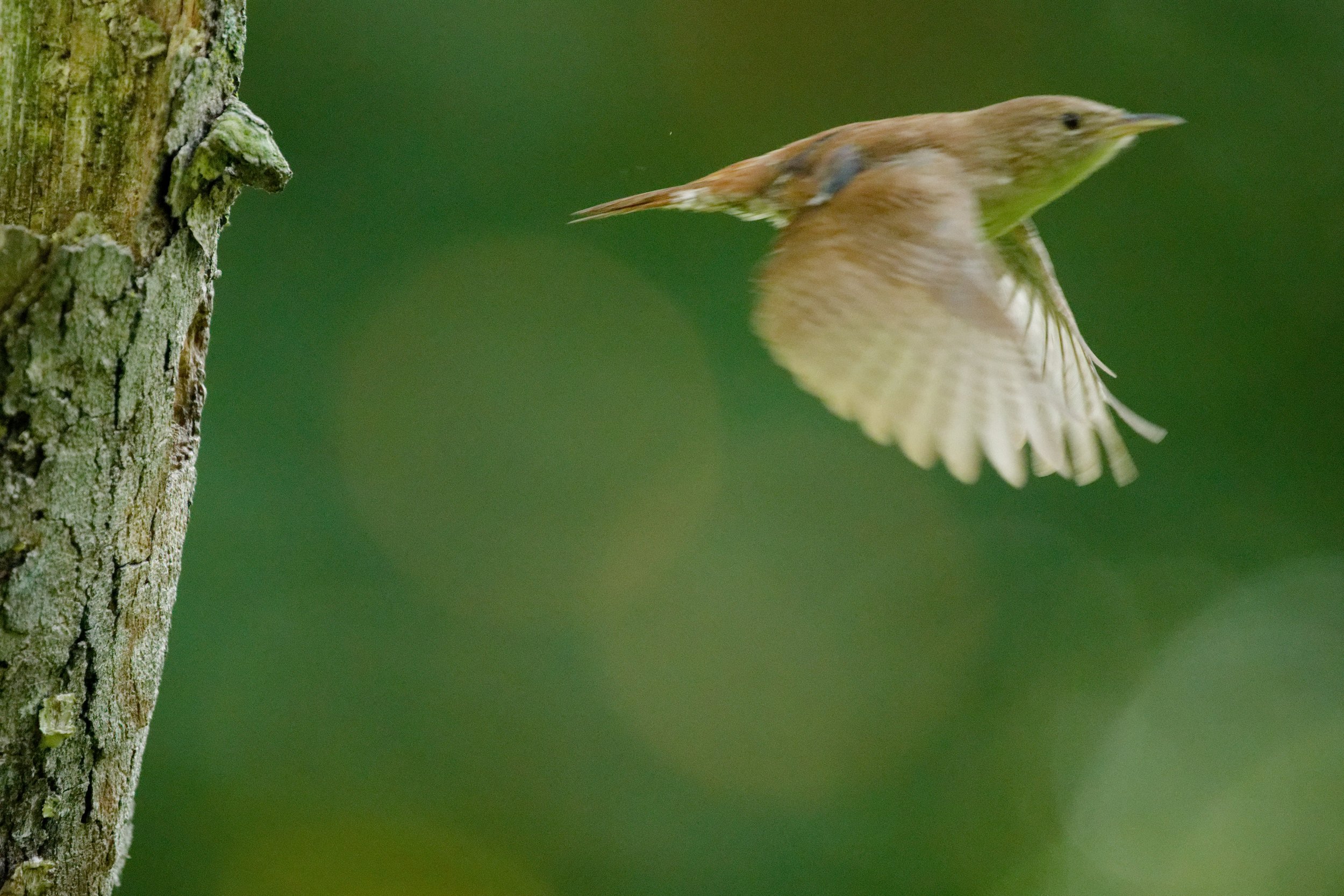
One of many examples of a missed flight shots because of how fast the birds took off. This was taken at 1/800 at ISO 8000. This was taken on the OM-5 Mark II so my ISO was already in the extended range.
What Surprised Me:
One thing that comes to mind that surprised me was that I did not tire of trying to photograph these little birds. It may sound repetitive to go into the same blind to photograph the same birds for over a month. I think it helps that they are little balls of energy and non stop.
There wasn't a day I was out there where I did not see something new or some different behavior. There was always something to learn.
One day would be the male singing on the perch, the next the female would be bringing nesting materials. Even when the adults were just quietly sitting and poking their head out of the cavity, there were ample opportunities to observe different behaviors and nuances. Such as why did the bird all of a sudden stick out their head? Was there a noise that caught their attention, did the male call from the hedge row, did they simply want some fresh air? All these things offer more insights into the bird's daily lives and routines. Information you can use to make photography easier.
What the Experience Taught Me:
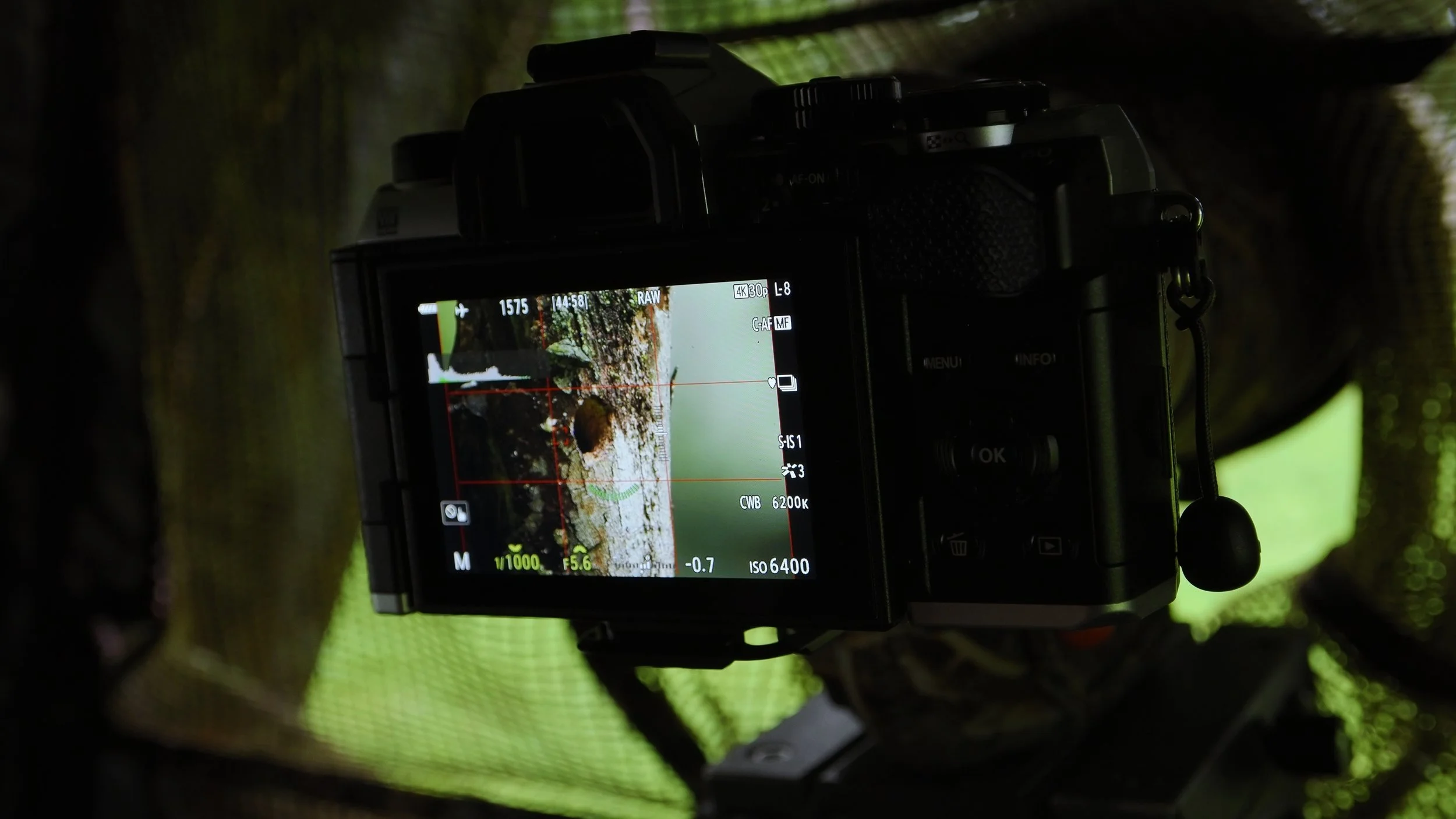
Piggy backing on what surprised me, this experience taught me a simple truth that I already knew but it was reinforced. Any amount of time behind the camera is valuable. Even the time sitting waiting for something to happen was valuable time to dial in your camera settings, try different settings, try to use Pro Capture, work on reading and interpreting behavior. This time cannot be learned by simply reading about camera settings or watching a video. This is just the time required to get proficient and comfortable with your camera. This is what makes having a camera in hand feel second nature, so when you have the opportunity to capture a great moment in front of you, you don't need to think, you can just compose.
Don’t shy away or feel any less if at the moment you are only able to photograph animals that are local to you. Even if they may be one of the most common and well studied species in the area, you can still work on creating compelling photos of them.
And if you can work at creating an interesting photo of a common species, then imagine what you will be able to do when you find a more “exotic” species. You will have an expanded tool kit to work from, which is really when photography gets exciting!
Another thing that I hope is obvious here is that you can build quite the portfolio in a months time, with subjects were you don’t even need to leave your backyard for.